

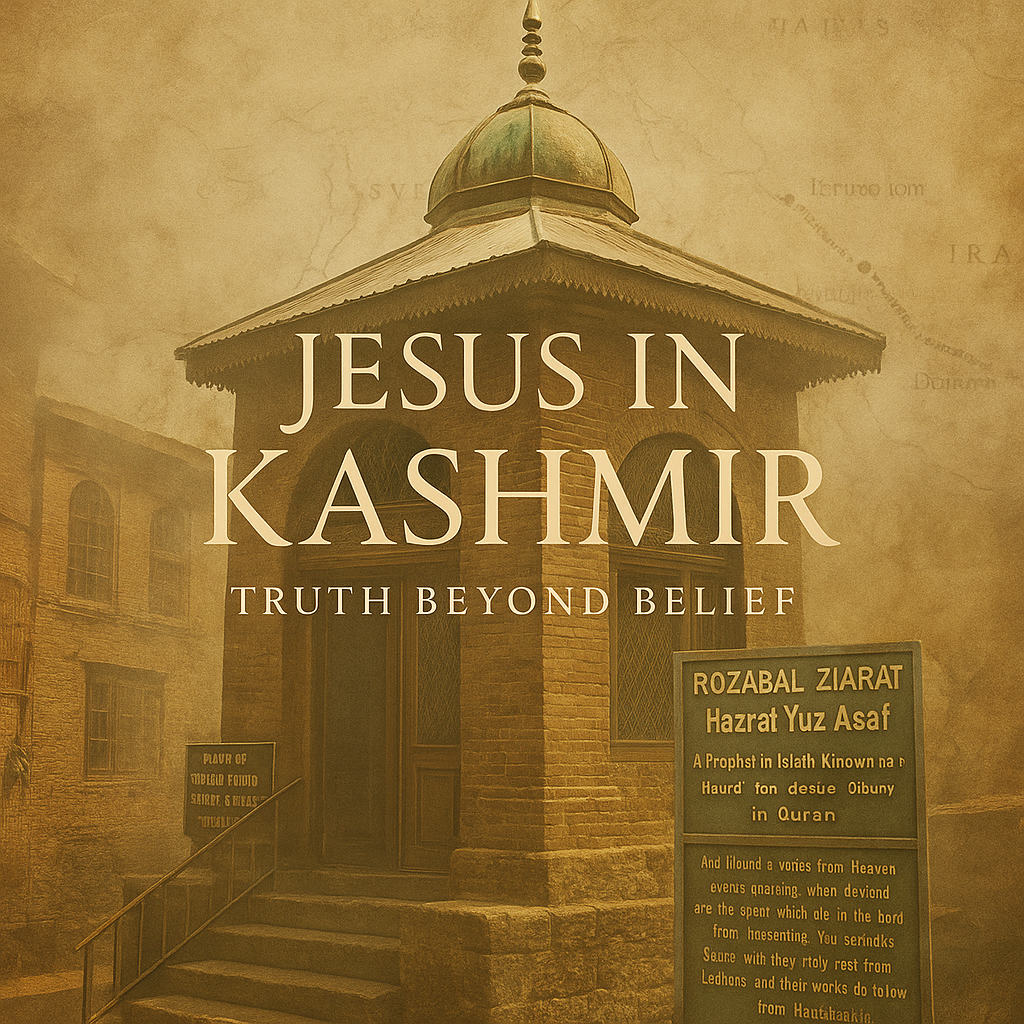
JESUS’ TOMB IN SRI NAGAR
A personal journey to Srinagar that changed everything I believed about the life and death of Jesus Christ.
For decades, scholars have debated the so-called “Lost Years of Jesus” – the unaccounted time between ages 13 to 30 in the life of Christ. While the Bible remains silent about this period, Indian scrolls, Buddhist legends, and travel records suggest a hidden journey through the East. Among the many claims and theories, one physical site stands tall, inviting seekers from across the world: The Rozabal Shrine in Srinagar, Kashmir.
I did not go there out of curiosity. I went with questions that haunted me for decades. And what I found there was not merely a tomb – it was a doorway to forgotten truths.
The Man Known as Yuz Asaf
Local tradition in Kashmir speaks of a wise man named Yuz Asaf, a prophet who came from the West, settled in Kashmir, preached love and healing, and finally died there. For centuries, the locals maintained that this Yuz Asaf was none other than Jesus Christ. Unlike the Western claim that Jesus ascended bodily to heaven, this tradition asserts that he survived the crucifixion and lived a long life in Kashmir.
The Rozabal Shrine, located in the Khanyar locality of Old Srinagar, is revered as the tomb of this saint. Though now managed by the Waqf Board as an Islamic shrine, it holds inscriptions and architectural features that hint at a more ancient and syncretic origin.
My Visit in 2011 – An Unforgettable Encounter
In 2011, I finally visited the Rozabal Shrine. The moment I stepped into the narrow lane leading to it, I felt a stillness in the air, as if time had paused to guard this sacred truth.
The tomb was modest, unassuming, and locked from outside. But what shook me was the cross-like symbol engraved on the tombstone, and the traditional feet carvings showing crucifixion wounds – unmistakable signs that aligned with the Biblical account.
What made the visit even more meaningful was meeting Dr. Fida Hassnain, the former Director of Archives, Archaeology and Museums, Jammu & Kashmir. A historian, Sufi, and fearless truth-seeker, Dr. Hassnain had devoted years to researching this theory. His warmth, sincerity, and clarity affirmed the very beliefs I had been forming.
He shared ancient Persian and Urdu texts referencing Jesus’s travels in India and Tibet, and even a diagram (which I still possess) outlining Jesus’s journey from Jerusalem to Srinagar, via Sindh, Ujjain, Puri, Nalanda, and Ladakh.
Why This Matters to the World
If Jesus did not die on the cross but continued his life and teachings in India, then it reframes not just Christianity but also the link between East and West. It opens the door to reincarnation, karma, and a shared spiritual heritage that modern religions have separated.
But why has the world ignored this?
Because accepting it would unravel centuries of dogma, challenge powerful institutions, and empower the East with spiritual legitimacy that colonialism tried to erase.
Silence, Suppression, and the Gatekeepers
The Rozabal Shrine was open to visitors until the early 2000s. But after rising interest from international researchers and documentary teams, the shrine was officially closed to the public and declared merely a Muslim saint’s tomb. My conversations with locals revealed something deeper – a silent understanding that this place holds more than what authorities are willing to admit.
Even the caretaker spoke in hushed tones. Some say rewards were offered for silence. Others simply fear backlash.
Yet the energy of the place cannot be contained.
My Reflections: More Than a Tomb
As I stood outside the shrine, tears filled my eyes. I wasn’t just a researcher anymore. I was a witness. A soul who had come face to face with a truth buried under centuries of manipulation.
Jesus in Kashmir is not a theory for me. It is a reality I touched, heard, and felt.
This is not a call to reject Christianity. It is a call to complete it – to restore the Eastern chapters of Christ’s story, to honor the Indian soil where he walked, healed, and finally rested.
A Study by Green Guru Dinesh Rawat, Environmentalist, Researcher & Author www.gloriesofindia.info | www.dineshrawat.live | www.greenmall.in | www.prakritibandhu.org