

Cities Without Temples, Without Crime, Without Writing
When we imagine ancient cities, we often think of towering temples, bloody battles, and scrolls of law carved into stone. But the Harappan civilization — one of the world’s oldest — defies these expectations. Spread across the Indus-Saraswati plains, cities like Rakhigarhi, Bhirrana, Kalibangan, Dholavira, and Harappa whisper a quiet sophistication.
These weren’t cities of kings or conquests. They were cities of calm — with no discovered central temples, no organized warfare, no clear political hierarchy, and no deciphered writing. And yet, they flourished.
 Urban Grace Without Power Structures
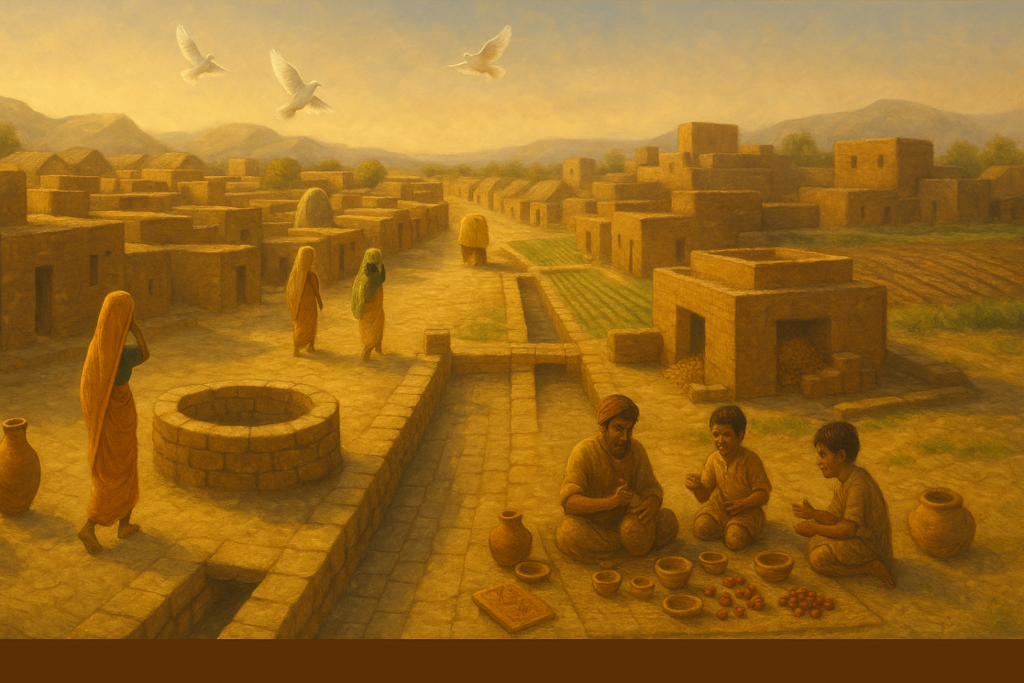
Rakhigarhi, the largest known Harappan site, spans nearly 224 hectares. Its streets follow strict grids. Homes had private wells. Drainage systems ran under walkways. Granaries stored surplus. But no grand palaces or shrines dominate its landscape.
In place of spiritual authority, perhaps collective dharma guided them. Their bricks weren’t just materials — they were codes of symmetry and sustainability.
 Bhirrana: Harmony at the Dawn
Dating back to nearly 8000 BCE, Bhirrana is possibly the oldest known site in the Harappan orbit. Located along the dried Saraswati River, it features mud platforms, handmade pottery, and continuous habitation layers. But again, no signs of monarchy, priesthood, or violence.
Isn’t it striking that the oldest Indian city shows no need for domination? Its rhythm seems guided by nature, trade, and ritual simplicity.
 Kalibangan: Spirituality in Soil
Kalibangan in Rajasthan astonishes archaeologists with its ancient ploughed fields — possibly the oldest known agricultural imprints. Fire altars suggest ritualistic reverence, but no towering religious complexes. It wasn’t spectacle, but subtlety — devotion rooted in routine.
Here, the sacred may have been the act of sowing, irrigating, and harvesting.
 Dholavira and Beyond: Intelligence in Infrastructure
Dholavira, though more western, reveals advanced water conservation systems — with reservoirs, dams, and check dams carved with planning genius. Its signboard of undeciphered script shows symbolic sophistication. But once again, no royal decree, no court records, no blood-stained histories.
Across these cities, we see intelligent standardization: uniform weights, brick sizes, artifact motifs. The Harappans seemed to value balance over domination.