

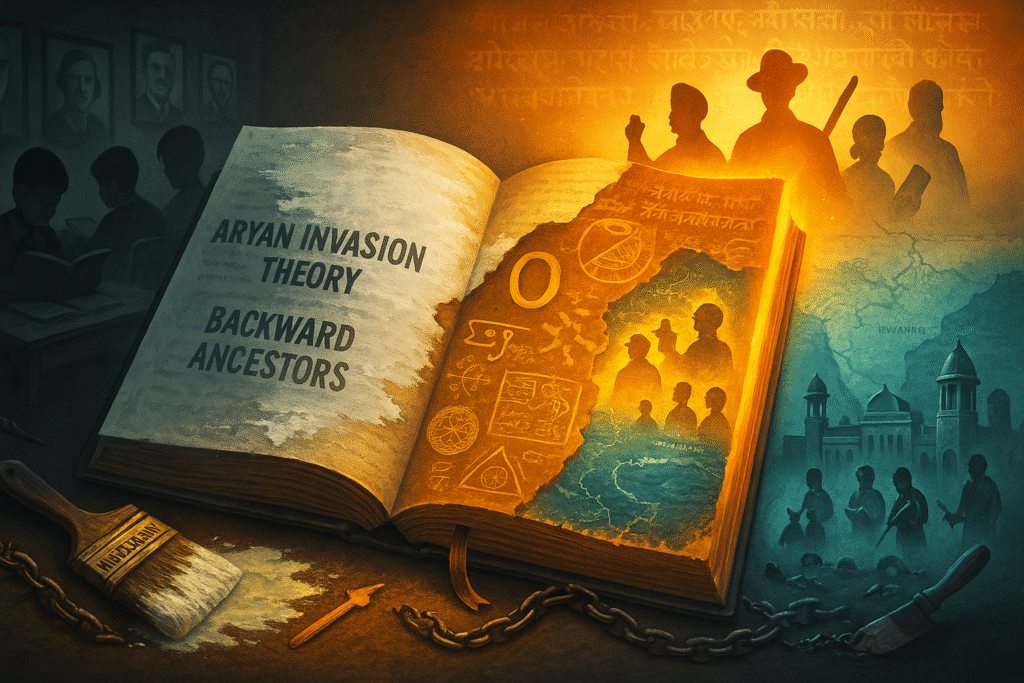
Introduction:
What if the story of India you grew up learning was never India’s story at all?
From school classrooms to competitive exams, the history fed to generations of Indians often begins with invaders and ends with colonizers. Glorious millennia of native wisdom, scientific innovation, social structures, spiritual evolution, and artistic achievement are reduced to footnotes—if mentioned at all. But who wrote this version? Who chose what to include, what to distort, and what to erase?
It’s time we ask: Who really wrote our history textbooks—and why did they leave India out of it?
The First Hijack: Colonial Manipulation of Indian History
When the British East India Company turned into a ruling power, they knew that to rule India permanently, it wasn’t enough to control her land. They had to control her mind. And the easiest way to do that? Rewrite her history.
Enter James Mill, a British economist and philosopher, who in 1817 wrote A History of British India—without ever stepping foot in India. Mill divided Indian history into three artificial categories: Hindu Period, Muslim Period, and British Period—presenting Hindu India as backward and superstitious, Islamic rulers as despotic, and the British as India’s saviors.
Following him, colonial administrators like Thomas Macaulay and Alexander Cunningham ensured the educational and archaeological records aligned with this distorted narrative. Macaulay’s infamous “Minute on Indian Education” (1835) declared Indian literature and sciences inferior to European knowledge and advocated replacing Indian learning with English education. The result? Indians began to doubt their own heritage.
The Formation of ASI and the Fabrication of “Facts”
The Archaeological Survey of India (ASI) was founded in 1861 by Alexander Cunningham. While on paper it aimed to preserve Indian monuments, in practice it became a tool to attribute India’s ancient marvels to foreigners or Islamic rulers, completely sidelining Vedic contributions.
Sites like the Taj Mahal, Qutub Minar, Red Fort, Fatehpur Sikri, and others were conveniently labeled as Mughal creations, ignoring architectural features that pointed to earlier Hindu or Jain origins. Similarly, ancient cities like Taxila, Nalanda, and Dwarka were either left unacknowledged or dismissed as mythical.
Thus, through colonial archaeology, the invader became the builder, and the builder was erased.
The Nehruvian Era: A New Mask, Same Motive
After Independence in 1947, one would hope India would reclaim her narrative. Sadly, that did not happen.
India’s first Prime Minister, Jawaharlal Nehru, was deeply influenced by Marxist and Fabian socialist ideals. His vision of history prioritized “secularism” and “modernization,” often at the cost of truth. Nehru and his education minister Maulana Abul Kalam Azad chose British-educated leftist historians to shape post-Independence textbooks.
This gave rise to a powerful group of historians based in institutions like JNU, ICHR, and NCERT—commonly referred to as the Marxist School of Indian History. Scholars like Romila Thapar, Irfan Habib, Bipan Chandra, and R.S. Sharma became gatekeepers of historical discourse.
They glorified invaders like Ghazni and Aurangzeb, vilified Hindu rulers like Pushyamitra Shunga and Samudragupta, denied the Vedic Saraswati River’s existence, labeled the Ramayana and Mahabharata as myths, and mocked India’s spiritual achievements as superstition.
Their agenda was clear: promote class struggle, erase national pride, and break continuity with India’s spiritual and civilizational roots.
NCERT and the Institutional Whitewashing
In 1975, NCERT (National Council of Educational Research and Training) was tasked with writing standardized history textbooks. What should have been a platform for reclaiming India’s story turned into a channel for ideological indoctrination.
Some startling examples from NCERT textbooks:
- The Aryan Invasion Theory was taught as unquestioned fact, despite mounting linguistic, archaeological, and genetic evidence to the contrary.
- Vedic knowledge, including mathematics, astronomy, and medicine, was dismissed or given one-line references.
- Temples, gurukuls, and civilizational achievements like town planning in Harappa or surgical tools in Sushruta Samhita were underplayed.
- The freedom struggle was painted as primarily non-violent, sidelining revolutionaries like Subhas Chandra Bose, Bhagat Singh, and the INA.
It was a history not meant to enlighten—but to alienate.
Breaking the Illusion: Truth Rising from the Ruins
In recent decades, a wave of independent researchers, archaeologists, and nationalists have begun to challenge the official narrative.
- Dr. Fida Hassnain and Holger Kersten uncovered hidden truths about Jesus in India.
- P.N. Oak questioned the Mughal origin of Indian monuments and exposed British-era distortions.
- S.R. Rao excavated Dwarka, providing material proof of the Mahabharata.
- The discovery of Bhirrana, Rakhigarhi, and the Saraswati River’s dried bed questioned the whole Aryan migration theory.
- Satellite imagery now confirms ancient river routes, submerged cities, and temple ruins, aligning with descriptions in ancient scriptures.
Despite being mocked or suppressed by academia, these voices are growing louder. They are not rewriting history—they are reclaiming it.
Why This Matters Today
History is not just about the past; it shapes our identity, unity, and future. A child taught that their ancestors were backward and superstitious grows up without pride or purpose. But a child taught about Aryabhata, Gargi, Chanakya, Sage Patanjali, and the world’s oldest republics like Vaishali and Lichchhavi, grows up with strength and clarity.
This is not about left or right. It is about right and wrong.
The Way Forward: Reclaim, Relearn, Rebuild
It’s time to:
- Rewrite history books based on archaeological evidence, indigenous sources, and oral traditions.
- Remove politically motivated distortions and restore balance and truth.
- Encourage multilingual exploration of ancient texts—from Sanskrit and Pali to Tamil and Prakrit.
- Integrate Indian knowledge systems—like Ayurveda, Vastu, and Yoga—into historical studies.
- Celebrate regional heroes, not just the Delhi Sultanate and Mughals.
India must no longer be a stranger to her own story.
Conclusion: The Pen Is in Our Hands Now
Our history textbooks weren’t written by seers, rishis, or yogis. They were drafted by foreign rulers and their ideological successors, who saw India not as Bharat Mata but as a resource to be exploited.
But the time has come. The sleeping lion is awakening, and India is rediscovering her own mirror—not the one held by the West, but the one polished by her ancestors.
Let the children of tomorrow grow up learning not just how they were ruled—but how they once ruled the seas of knowledge, the skies of consciousness, and the hearts of humanity.
A Study by Green Guru Dinesh Rawat, Environmentalist, Researcher & Author

www.gloriesofindia.info | www.dineshrawat.live | www.greenmall.in | www.prakritibandhu.org