

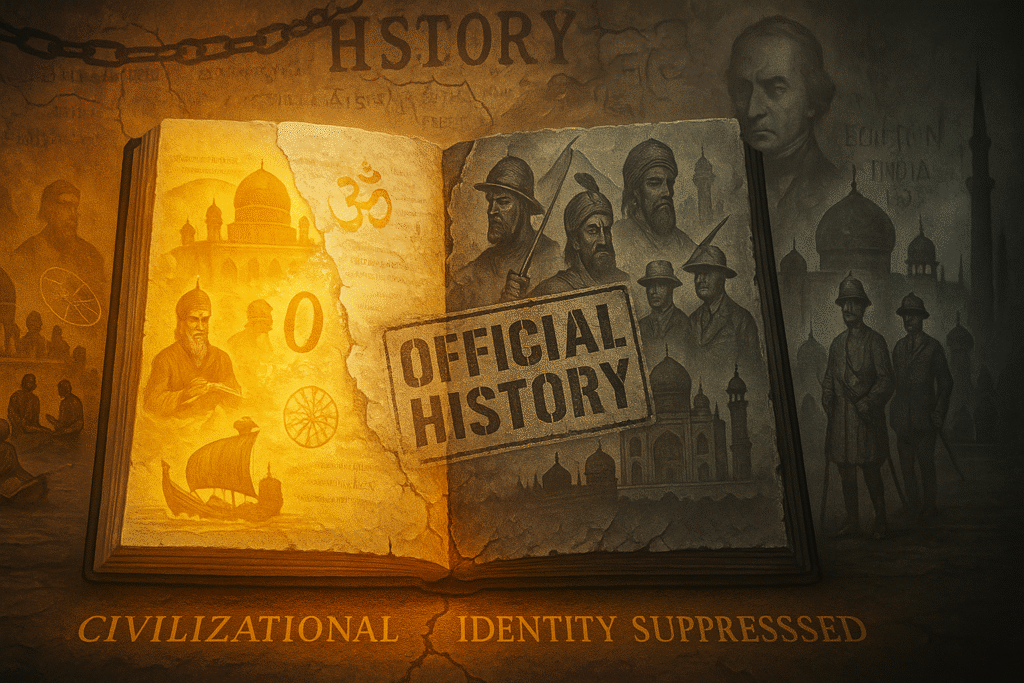
Introduction: A Story Interrupted
Pick up any standard Indian history textbook, and chances are it begins not with the builders of India, but the invaders—from Alexander to Ghazni, from Mughals to the British. The spotlight shifts from India’s glory to India’s subjugation. But why?
Why do we start our children’s understanding of India with defeat, foreign conquest, and suffering?
This was no accident. It was a calculated narrative architecture designed during colonial rule—and tragically continued even after independence.
 1. The Psychological Blueprint of the British Raj
The British didn’t just conquer India with muskets—they conquered Indian minds with textbooks.
Their goal?
“To make Indians think they were never truly great, and thus never rebel.”
Thomas Macaulay’s infamous 1835 Minute on Indian Education aimed to create a class of Indians:
- Indian in blood
- But British in taste, morals, and intellect
And so began a rewriting of history that ignored Vedic, Buddhist, and pre-Islamic glories, and instead began with invasions.
 2. From Builders to Invaders – A Shift in Narrative
Ancient Indian history—rich in philosophy, urban planning, science, art, and spiritual legacy—was reduced to a few lines.
Instead, pages were lavished on:
- Alexander’s short incursion (who actually retreated)
- Ghazni and Ghori’s raids, glorified as milestones
- Mughal architecture, presented as the pinnacle of Indian culture
- British reforms, marketed as civilizing efforts
This shift was intentional—to frame India as a land always shaped by outsiders.
 3. What Was Erased?
Modern textbooks conveniently skip or compress:
- Indus-Saraswati Civilization’s scientific brilliance
- Vedic era contributions in mathematics, astronomy, metallurgy
- Maurya and Gupta empires’ international influence
- Chola naval dominance and Southeast Asian links
- Universities like Takshashila and Nalanda, older than Oxford
Instead, the message becomes:
“Nothing mattered before foreigners arrived.”
 4. Control Through Chronology – The Power of What Comes First
In storytelling, first impressions shape perceptions.
When history books begin with invaders, students subconsciously internalize:
- That India was a land of chaos before outsiders brought order
- That our legacy is defined by defeat, not achievement
- That foreign rule is a normal, even positive, part of our past
This subtle psychological colonization is far more dangerous than armed conquest.
 5. Who Benefits from This Narrative?
- a) Colonial Powers:
It justified their loot as “civilizing the natives.”
- b) Post-independence political ideologies:
Some leaders embraced socialist, secular ideals that downplayed ancient Hindu identity to avoid communal tensions—further distorting history.
- c) Academic gatekeepers:
Westernized historians and Delhi-centric institutions continued the colonial line to preserve their intellectual monopoly.
 6. The Echo Chamber of School Curricula
Despite independence in 1947, textbook boards like NCERT:
- Retained colonial frameworks
- Glorified the Mughal period disproportionately
- Underplayed the atrocities of invasions and temple destruction
- Ignored regional heroes like Lalitaditya, Rani Durgavati, Lachit Borphukan, Krishnadevaraya
This has created generations disconnected from their real civilizational identity.
 7. What Needs to Change?
 Begin with India’s indigenous civilization: Indus–Saraswati, Vedas, Mahajanapadas Highlight real contributors: Aryabhata, Chanakya, Kalidasa, Rajaraja Chola Expose invaders truthfully: Document destruction, slavery, and forced conversions Include regional history: Northeast, South, and tribal contributions Teach with pride and balance, not shame and distortion
History must inspire, not just inform.
 8. Reclaiming Our Timeline
History isn’t just about the past—it shapes a nation’s self-worth.
When children learn their country was repeatedly invaded and ruled by outsiders, without knowing their ancestors once led the world in trade, science, and dharma, they grow up disconnected from their roots.
It’s time to reclaim our narrative, not with hate—but with truth, pride, and clarity.
 Conclusion: Let’s Start Where Our Story Truly Begins
India’s story doesn’t begin with Alexander’s retreat or Ghazni’s plunder.
It begins with:
- Harappan engineers designing underground drains
- Vedic seers composing eternal hymns
- Buddhist monks teaching peace across Asia
- Temple builders, mathematicians, yogis, and scientists illuminating the world
Let us tell our story, in our voice, to our future.
“A Study by Green Guru Dinesh Rawat, Environmentalist, Researcher & Author”

www.gloriesofindia.info | www.dineshrawat.live | www.greenmall.in | www.prakritibandhu.org