

Introduction: A Language Rooted in Soul, Not Just Syntax
India’s cultural soul has always been nurtured by its languages. Among them, Hindi stands tall—not just as a national language, but as a powerful medium of thought, feeling, and articulation. While English became the imposed language of administration and academia during colonial times, Hindi remains the language of the heart, the home, and the homeland.
It’s time to ask—is Hindi actually better than English in speech and writing? The answer, backed by logic, emotion, and linguistic heritage, is a resounding yes.
1. Phonetic Clarity – You Write What You Speak
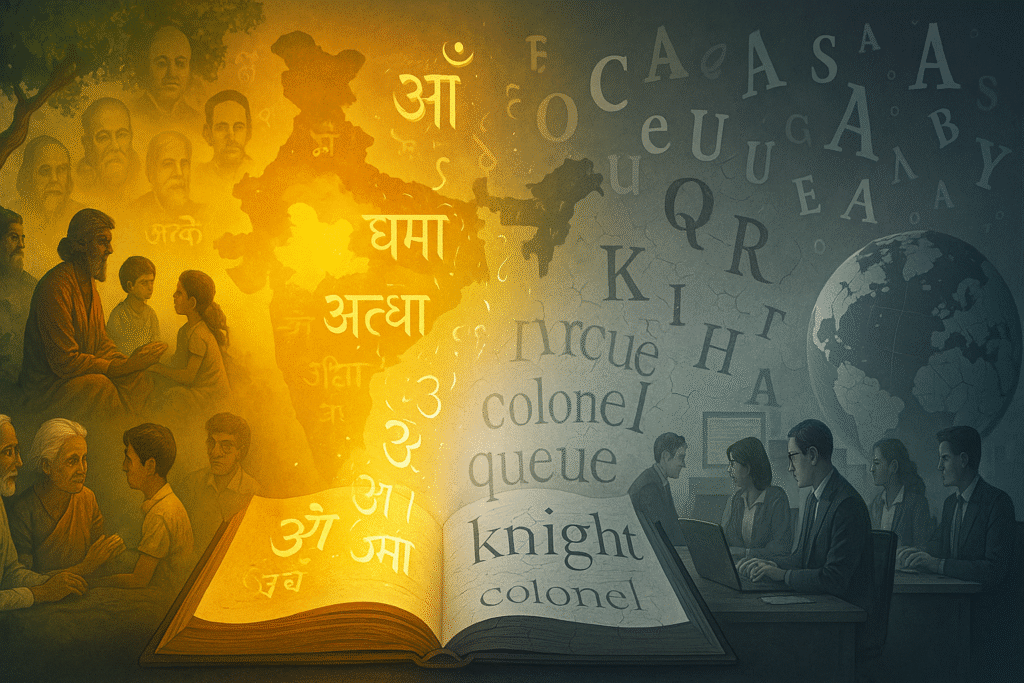
Hindi is completely phonetic. Every letter has a fixed sound, and every word is pronounced exactly as it is written. No silent letters. No confusing spellings like ‘colonel,’ ‘queue,’ or ‘knight.’
In contrast, English has irregular pronunciations, silent letters, and inconsistent spelling rules. This makes learning and articulation harder, especially for children or non-native speakers.
2. Better for Thought Structuring and Memory
Hindi follows a logical sentence structure that mimics the natural flow of human thought. It builds from subject to action to details, allowing the mind to think and speak in sync.
Example:
English – I am going to the market.
Hindi – मैं बाजार जा रहा हूँ। (I market going am.)
The Hindi format reflects deeper cognitive sequencing, aiding mental clarity, memory retention, and speech flow.
3. Precision and Poetic Power in Writing
Hindi words have deeply layered meanings that connect with culture, philosophy, and nature. Words like:
– ‘Dharma’ – not just religion, but cosmic duty
– ‘Atma’ – soul, not merely ‘self’
– ‘Shraddha’ – reverence mixed with faith
English often lacks equivalents for such nuanced expressions. Hindi allows a richer, more authentic emotional and philosophical expression in writing.
4. Rich Literary Heritage and Emotional Range
From Tulsidas, Kabir, Premchand to Dinkar, Bachchan, and Mahadevi Verma, Hindi’s literary tradition expresses every human emotion—love, patriotism, courage, grief, and devotion—with unmatched depth.
English may have Shakespeare and Wordsworth, but Hindi has its own timeless treasures that reflect India’s inner voice.
5. Hindi Connects Across Generations and Regions
Unlike English, which is often limited to elites or urban sectors, Hindi is understood across India—either directly or via its sister languages like Bhojpuri, Rajasthani, Awadhi, Haryanvi, and Maithili.
When you speak Hindi, you’re not just using a language—you’re reconnecting with your family, your roots, and your civilization.
6. Scientific Structure – Based on Sound and Energy
Sanskrit, the root of Hindi, is a vibration-based language. Each letter (अ, इ, उ, ऋ, etc.) resonates with specific parts of the human body. Hindi retains much of this vibrational purity. This makes Hindi and other Indic languages more aligned with consciousness, breath, and speech energy.
English, derived from Latin and Germanic roots, is more mechanical, not energy-aware.
7. English Is a Utility Language—Hindi Is an Identity
English may be global, but it doesn’t carry our soul. It is a tool, not a torchbearer. Hindi, on the other hand, carries cultural memory, ancestral wisdom, and national character.
To abandon Hindi in favor of English is like choosing plastic flowers over real ones—easier to maintain, but lifeless.
8. Hindi and India’s Regional Languages – A Family of Cultural Powerhouses
Hindi is not alone in its expressive might. It is part of a grand linguistic family that includes Sanskrit, Tamil, Telugu, Marathi, Bengali, Gujarati, Kannada, Malayalam, Odia, Punjabi, and many more. These languages are not dialects—they are civilizational tongues with their own grammar, poetry, sciences, and philosophies.
While English dominates due to historical imposition, our regional languages continue to thrive in villages, songs, scriptures, and stories. Each carries ancestral memory and spiritual wisdom.
By strengthening Hindi, we also uplift this entire Bharatiya language ecosystem, preserving diversity within unity. Together, they form the soul-voice of Bharat—far more vibrant and meaningful than any borrowed language.
Conclusion: Reclaiming Our Tongue Is Reclaiming Our Pride
English has its place in the modern world—international communication, business, and science. But let us not forget that true identity lies in expression that feels natural, authentic, and deep. Hindi offers that and more.
It’s time to make Hindi—not just spoken at home—but the language of thought, literature, science, and governance. The British are gone; why should their language continue to rule our minds?
A Study by Green Guru Dinesh Rawat
Environmentalist | Researcher | Author
www.gloriesofindia.info | www.dineshrawat.live | www.greenmall.in | www.prakritibandhu.org