

Can We Still Trust Historians and Scientists?
Can We Still Trust Historians and Scientists?
Historians and scientists are often presented as custodians of truth. Textbooks, classrooms, and media repeat their conclusions as unquestionable. Yet, when evidence is ignored or inconvenient data is dismissed, their authority deserves re-examination.
History’s Gaps and Contradictions
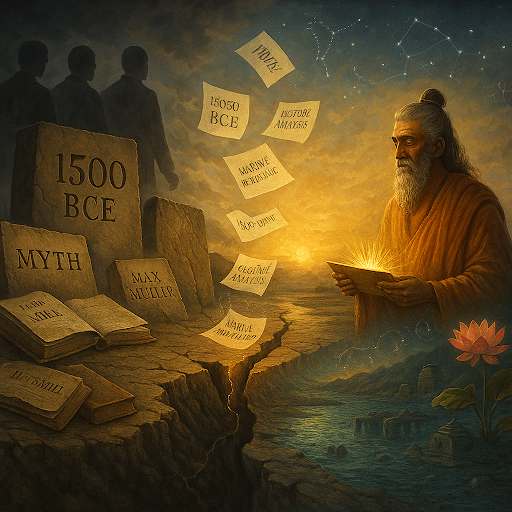
Colonial-era writers shaped India’s past for political ends. James Mill (1817) never visited India, yet portrayed Hindu civilization as barbaric. Max Müller dated the Rigveda to 1500 BCE — later admitting in private letters that it was “provisional” guesswork (Müller, Chips from a German Workshop, 1867). Despite this, the date persists in textbooks.
The Saraswati River, once dismissed as mythical, is now confirmed by satellite imagery and isotope analysis (Yashpal et al., Current Science, 1980; Valdiya, Geological Society of India, 2013). Marine archaeology at Dwarka revealed submerged structures matching epic descriptions (National Institute of Oceanography, Goa, 2002). Yet, historians still call the Mahabharata a myth, a double standard compared to Troy — which was rediscovered through Homer’s Iliad.
Science’s Unanswered Questions
Darwin’s theory remains foundational, but paleontology admits glaring gaps. The Cambrian Explosion (~541 Mya) saw the sudden emergence of most animal phyla within 20 million years (Gould, Wonderful Life, 1989). The fossil record offers no gradual pathway. Genetics explains variation but not origins of complexity.
Cosmology also faces paradoxes. The Big Bang posits creation “from nothing,” but what is “nothing”? Lawrence Krauss’ “vacuum fluctuations” are still something (Krauss, A Universe from Nothing, 2012). The problem of time beginning at the Big Bang remains unresolved (Penrose, Cycles of Time, 2010). Consciousness is another frontier: neuroscience cannot explain subjective experience, termed the “hard problem” (Chalmers, 1995).
The Deeper Problem: Arrogance
Error is natural in inquiry; dogmatism is not. Instead of humility, mainstream historians and scientists often guard authority. Questions outside their framework are labeled “pseudo-history” or “pseudo-science.” Critical thinking is encouraged only when it doesn’t threaten orthodoxy.
India’s Alternative Model
Indian civilization valued śāstrārtha — open debate. Competing schools of Vedanta, Nyaya, Buddhism, and Jainism argued fiercely, yet preserved pluralism. Epics integrated history, cosmology, and philosophy. Indian cosmology accepted cycles of creation and dissolution, not one rigid narrative. This intellectual humility is what modern scholarship lacks.
Conclusion
The question is not whether historians and scientists make mistakes. It is whether they are willing to admit them. Without openness, they cease to be seekers of truth and become gatekeepers of power. Trust can return only if scholarship embraces dialogue, humility, and courage — values that Indian tradition has long considered sacred.