

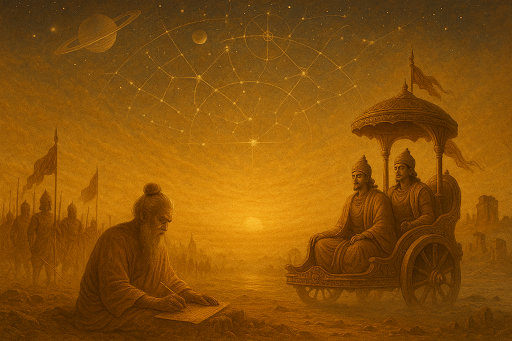
Mahabharata — Not a Mythology: The Historical War of 5562 BCE
Mahabharata — Not a Mythology: The Historical War of 5562 BCE
When truth sleeps under layers of dust, time itself becomes the witness.
The Mahabharata is not a poem of imagination; it is the diary of a civilisation that looked at the sky and wrote what it saw.
Every sunrise, eclipse, and planetary position recorded by sage Vyāsa was real — written in the heavens of 5562 BCE.
The Forgotten History
For centuries, colonial scholars dismissed the Mahabharata as myth, placing India’s past in a fog of uncertainty.
But India’s own tradition never called it “myth.” Itihāsa means “thus it happened.”
And when modern astronomy returned to its pages, the sky spoke the same language our ancestors had preserved.
When the Stars Aligned
Researcher Nilesh Nilkanth Oak meticulously analysed over 150 celestial references in the epic.
Using NASA-validated software, he rewound the cosmic clock until the patterns of the heavens matched the descriptions —
the lunar eclipse before the war, the Saturn–Aldebaran alignment, the dawn when Bhīṣma fell on the arrows of time.
On 22 November 5561 BCE, the sun rose exactly as described by Vyāsa.
The planets stood in their assigned houses.
No other century, no other millennium fits those details.
In that instant, the Mahabharata stepped out of legend and into history.
Land That Still Remembers
Travel to Kurukshetra, and the soil still bears silence where armies once stood.
At Hastinapur, archaeologists have uncovered continuous habitation layers reaching back seven thousand years.
The submerged ruins near Dwaraka whisper of cities that sank when the sea reclaimed the shore.
Local names, folk songs, and temple traditions keep memory alive —
not myth, but collective remembrance that has outlived empires and maps.
A Civilisation of Science and Spirit
What kind of people could record the sky with such precision?
They were astronomers and philosophers, warriors and poets —
a civilisation that measured time in yugas and mapped destiny among stars.
While the world struggled to count seasons, Bharat’s seers were charting planetary orbits and teaching ethics through epic.
The Mahabharata is therefore not only a record of war; it is a reflection of scientific consciousness clothed in spiritual wisdom.
Echo of Dharma
Beyond the battlefields, the Mahabharata teaches the eternal geometry of life —
how the straight line of truth bends under greed, and how dharma restores its balance.
When Arjuna hesitated, Krishna did not offer faith — He offered understanding.
This dialogue of awareness, the Bhagavad Gita, remains the world’s most luminous manual of human duty.
Why 5562 BCE Changes Everything
Accepting the Mahabharata as real history does more than correct a date;
it re-centres the origin of civilization.
It tells the world that while others were building huts, Bharat was building moral philosophy and cosmic science.
Our heritage did not begin with foreign kings — it began with the consciousness of dharma.
Continuum of Bharat
The river of time that carried the Mahabharata also flowed through Buddha, through Īśa, through today.
It is the same current of compassion and inquiry that never dried.
From the Saraswati’s banks to the laboratories of space scientists, Bharat’s quest for truth has never paused — only changed form.
“When truth is written in the stars, it cannot be erased by history books.”