

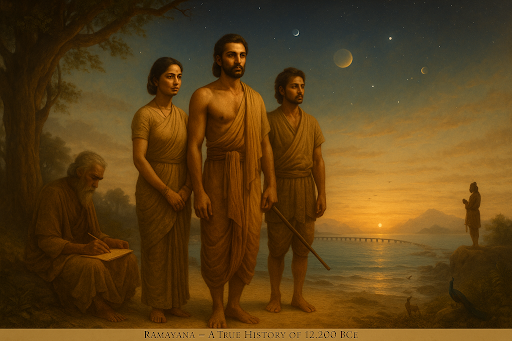
Ramayana — A True History of 12,200 BCE
Ramayana — A True History of 12,200 BCE
When history forgets, the stars remember.
And among the oldest memories of humankind stands the tale of a prince who walked not in legend, but in light — Śrī Rāma.
The Rāmāyaṇa is not the invention of a poet; it is the retelling of a journey so ancient that even the heavens preserve its coordinates.
The Memory That Would Not Die
For generations, colonially trained historians reduced India’s epics to “mythology.”
They asked: Where is the proof?
But India never preserved history in stones and papyrus alone. She encoded it in rhythm — in stories aligned with the pulse of the cosmos.
Valmiki’s verses are not fantasy. They are a stellar diary — a celestial GPS of an age long before recorded history.
In 2011, researcher Nilesh Nilkanth Oak undertook a rigorous astronomical decoding of the Rāmāyaṇa.
He analyzed more than 500 references to planetary positions, eclipses, and solstices described by Valmiki.
When those clues were plotted using modern sky-simulation software, every configuration converged upon one astounding epoch — 12,200 BCE.
When the Sky Told the Story
At the time of Rama’s birth, Valmiki notes a specific alignment —
“When five planets were exalted and the Moon was with Jupiter in Cancer.”
Oak traced that precise configuration to the sky of 10 January 12,209 BCE, when all conditions matched exactly.
Further celestial events — the eclipses during the Vanavasa, Hanuman’s leap to Lanka under a specific lunar phase, and the planetary shifts at Ravana’s fall — all coincide within that same epoch.
Such accuracy cannot arise from imagination.
It means that the Rāmāyaṇa was composed by eyewitnesses of the heavens — seers who looked up and recorded what they saw.
The Geography That Confirms It
Science has now caught up with scripture.
Satellite imagery from NASA and ISRO reveals the Rama Setu — a chain of limestone shoals connecting India and Sri Lanka.
Geological studies date portions of the bridge between 10,000 – 12,000 BCE, perfectly matching Oak’s timeline.
Local oral traditions in Rameswaram and Dhanushkodi have preserved that memory unbroken — every name, every shrine, every tide whispering of the journey southward.
From the forests of Chitrakoot to the ancient shoreline of Lanka, the geography of the epic remains traceable.
Archaeological digs in Ayodhya show continuous habitation since pre-Neolithic times.
The earth itself still bears the footprints of the tale.
Rama — The Human Ideal, Not the Mythic God
To see Rama as myth is to misunderstand the Indian mind.
In Bharat, divinity is not distant; it is human perfection raised to its highest possibility.
Rama was a historical being who embodied ṛta — the cosmic order that sustains all creation.
He lived by dharma not because it was convenient, but because it was truth.
He was a son, a king, a warrior, a husband — yet above all, he was a reminder that power is sacred only when governed by compassion.
His exile was not a punishment but a pilgrimage — a walk through forests that were once sacred ecological corridors.
In the Ramayana’s descriptions of flora and fauna, modern botanists recognize species native to those exact regions.
Thus, even its environmental detail proves it was written by those who walked that land, not imagined it.
Science, Faith, and the Continuum of Civilization
The dating of 12,200 BCE redefines the boundaries of human history.
At that time, much of the world was emerging from the Ice Age.
Yet India already had astronomers, grammarians, poets, and philosophers who could map the sky with mathematical precision.
The Rāmāyaṇa therefore belongs not to mythology but to a civilizational continuum that stretches back to the Vedas and forward to the Mahābhārata.
Its worldview unites observation and reverence — science as the language of the sacred.
“When the sky itself becomes scripture, every sunrise is a verse of truth.”
Echoes of a Universal Journey
Beyond India, the echoes of Rama’s story appear in many lands — in Southeast Asia, where temple walls still carve his path; in Mesopotamian myths resembling the bridge of the gods; in early European folklore describing a sun-prince who returns to restore order.
These are not borrowings but reflections — ripples from Bharat’s ocean of narrative that reached every shore.
Rama’s life teaches that civilizations rise not through conquest but through conduct.
His dharma was not about domination; it was about alignment with the natural rhythm — a lesson our modern world needs urgently.
Why It Matters Now
Accepting the Rāmāyaṇa as real history does not merely satisfy national pride; it transforms our understanding of humanity’s timeline.
It places Bharat not at the periphery but at the fountainhead of civilization — a cradle where ethics, astronomy, ecology, and governance first met in harmony.
When we see Rama as historical, the bridge between faith and fact collapses.
We realize that spirituality can be empirical, and science can be sacred.
The Rāmāyaṇa reminds the world that history is not only what archaeologists dig up — it is what stars and rivers remember.
“The truth of Rama is written not in stone, but in the rhythm of the cosmos.”