

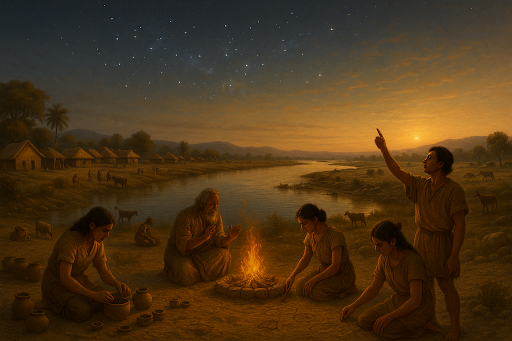
Pre-10,000 BCE Bharat — Evidence of Human Settlement Before the Holocene Peak
When the rest of the world still lived in the shadow of the Ice Age,
the land of Bharat had already awakened to light, rhythm, and reflection.
Here, on the banks of the Saraswati and Drishadvati,
human hands shaped clay, measured stars, and sang hymns to the dawn.
Long before Egypt or Sumer, the story of civilization had begun — quietly — in India’s soil.
The River Before History
Textbooks tell us India’s history begins around 2500 BCE with the Indus Valley.
But archaeology tells a far older truth.
At Bhirrana in Haryana, on the dry bed of the ancient Saraswati,
scientists have uncovered settlement layers dating back nearly 10,000 years — around 8000 BCE.
Pottery fragments, hearths, beads, and burial sites reveal a people
who had already learned to plan, build, and trade.
Sediment analysis and radiocarbon dating confirm that these settlers
flourished when the Saraswati River still flowed in full glory,
fed by Himalayan glaciers before the Holocene floods reshaped the plains.
Even satellite imagery today traces the ghostly river-path
that once carried life through what is now desert.
This was not prehistory; this was early memory —
a civilization older than what we have been taught to imagine.
Before Agriculture, There Was Awareness
At Mehrgarh, near the Bolan Pass,
evidence of early farming appears around 9000 BCE.
But at Bhirrana and Rakhigarhi, the rhythm of life was already settled —
granaries, cattle domestication, and signs of community planning appear centuries earlier.
Their pottery carried geometric patterns — the first whispers of symbolic art.
Their hearths, aligned east–west, suggest an understanding of celestial cycles.
These were not wanderers of chance but seekers of order —
the proto-Vedic ancestors who saw divinity in direction and design.
The Continuum of Consciousness
Around 10,000 BCE, as glaciers melted and the Holocene warmth began,
the people of Bharat were already transitioning
from hunter-gatherers to knowledge-keepers.
Theirs was not just a change in livelihood, but in awareness.
They measured time through constellations,
observed the rhythm of seasons,
and expressed gratitude through fire and sound.
This explains why the Rig Veda, though orally preserved,
describes rivers that no longer flow, and skies that match pre-Holocene star-maps.
Its verses are not inventions of 1500 BCE but echoes of this older world —
a science encoded in song.
Science Meets the Sacred
Archaeology and tradition now converge.
When we trace Bharat’s civilizational arc,
it flows seamlessly — from pre-Holocene settlements → Vedic culture → Epic epochs → modern Bharat.
At one end stands Bhirrana (~8000 BCE) — evidence of rooted life and ritual.
At another, the Rāmāyaṇa, whose astronomical data places Śrī Rāma around 12,200 BCE,
when humanity rebuilt after the last glacial retreat.
Later came the Mahābhārata, precisely dated by sky-patterns to 5562 BCE,
the culmination of a moral and philosophical age.
Each is not a separate civilization but a wave in the same eternal ocean —
one expressing settlement, one dharma, one philosophical depth.
Forgotten Builders of Time
The people of Bhirrana left behind silent proof —
circular hearths shaped like early yajña-vedis,
microlithic tools sharper than bronze blades,
and shells from distant coasts hinting at trade.
They planned their homes by the compass of sunrise.
They buried their dead with care, facing east —
not superstition, but a cosmological code: life returning to light.
Their memory did not vanish.
It evolved into the sacred geometry of fire-altars,
the mandala of the Vedas, and the temple architecture of later ages.
Echoes in the Epics
When Rama walked from Ayodhya to Lanka,
he passed forests that had been sanctuaries since these earliest times.
The flora and fauna described by Valmiki match the ecology of that ancient period.
When Krishna fought the war of dharma at Kurukshetra,
he stood on soil already rich with the ashes of forgotten generations.
Thus the Rāmāyaṇa and Mahābhārata are not beginnings of civilization —
they are the flowering of a seed planted in the Saraswati Valley millennia before.
Re-Membering the Ancient Whole
To rediscover Bharat’s antiquity is to see time differently.
For the West, history is linear — born and buried.
For Bharat, history is cyclical — remembered and reborn.
Every age, from Bhirrana to Rama to Krishna,
is part of a single heartbeat: the rhythm of ṛta — the cosmic order.
Modern dating techniques — thermoluminescence, carbon-14, and isotope analysis —
confirm habitation in northwest India from at least 12,000 years BCE,
and continuous evolution through the Holocene.
The more we dig, the older Bharat becomes —
not a nation of myths, but a memory of consciousness.
“The Rig Veda is not where our story begins — it is where our ancestors paused to sing.”
The Light That Never Faded
When we recognize the 8,000 BCE Bhirrana settlement,
the 12,200 BCE Rama era, and the 5562 BCE Mahabharata epoch
as chapters of one unbroken narrative,
we reclaim our rightful timeline — not of conquest, but of continuity.
Civilization did not arrive in Bharat; it arose here —
nurtured by rivers, guided by stars, preserved by sages.
And though empires have fallen and calendars changed,
the rhythm that began before 10,000 BCE still beats in this land.
“History may forget its beginning — but the earth remembers where consciousness was born.”