
BHARAT: MOTHER OF EDUCATION & DISCOVERY
The Cradle of Knowledge
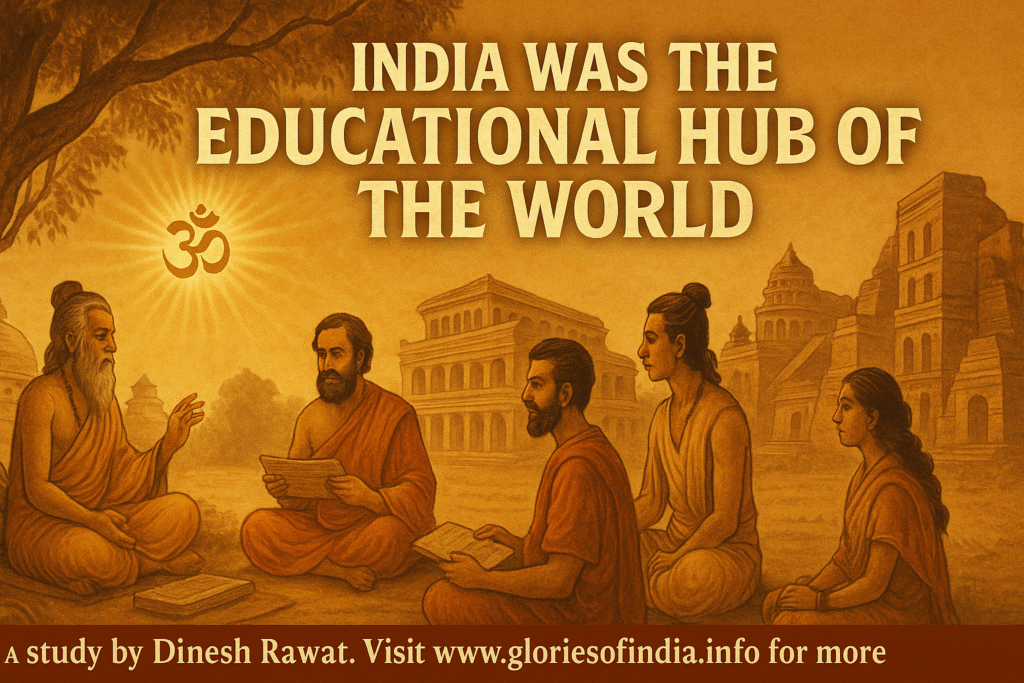
Before Harvard, before Oxford, before even Plato’s Academy, there was India—a land where the pursuit of knowledge was not just encouraged, it was sacred. The syllables of Sanskrit echoed in massive halls of learning, sages discussed metaphysics with kings, and students from across Asia came to learn in this ancient civilization. India was not just part of the global education system—it was the origin of it.
Takshashila: The World’s First Known University
Founded around 700 BCE, Takshashila was more than an educational institution—it was an intellectual civilization. Located in what is today Pakistan, Takshashila taught over 64 disciplines including:
- Philosophy
- Medicine
- Surgery
- Law
- Military Science
- Astrology
- Mathematics
Students from China, Babylonia, Greece, Arabia, and far-off lands journeyed to study under India’s brilliant sages. One of its most celebrated products? Chanakya (Kautilya)—the mastermind behind the Maurya Empire and author of the Arthashastra, a timeless manual on governance and economics.
 Nalanda: A Beacon in the East
While Takshashila lit the torch, Nalanda University made it a blazing sun. Established in the 5th century CE in Bihar, Nalanda became a symbol of India’s intellectual supremacy. At its peak, Nalanda had:
- Over 10,000 students
- More than 2,000 teachers
- A nine-story library called Dharma Gunj
- Studies in Buddhism, Vedas, logic, medicine, astronomy, mathematics, and arts
The Chinese scholar Xuanzang, who spent years at Nalanda, described it as a place where debate and learning never ceased, where knowledge was pursued for its own sake, not for wealth or jobs.
 The Gurukul System: Soul-Based Education
In the Gurukul tradition, students lived with the guru in natural settings—forests, hermitages, or temples—imbibing knowledge along with discipline, ethics, and spirituality. Education was free, personalized, and holistic.
Subjects included:
- Sanskrit, Vedas, and Upanishads
- Grammar and logic
- Ayurveda and surgery
- Mathematics and astronomy
- Art, music, and spiritual sciences
The goal was to create enlightened beings, not just degree holders. The teacher was a parent, mentor, and spiritual guide rolled into one.
 India’s Intellectual Gifts to the World
 Mathematics:
India invented zero, decimal system, algebra, and trigonometry. Aryabhata calculated the Earth’s rotation centuries before Galileo. Bhaskara II gave the world concepts close to calculus.
 Medicine:
Charaka’s Samhita and Sushruta’s surgical texts gave the world early plastic surgery, cataract operations, and advanced medical ethics. Sushruta described 300+ surgical procedures and 120 instruments.
 Astronomy:
Aryabhata’s theories of planetary motion, eclipses, and the spherical Earth were revolutionary. He estimated the Earth’s diameter with amazing accuracy in the 5th century CE.
 Linguistics:
Panini’s Ashtadhyayi is the earliest known scientific grammar of any language and inspired modern computer science with its algorithmic brilliance.
 Spiritual Wisdom:
Yoga, meditation, and Advaita Vedanta offered the world the tools for inner transformation—something even modern psychology embraces today.
 Students Came from Far and Wide
India’s reputation as the Vishwaguru (Teacher of the World) wasn’t a myth—it was documented. Travelers and scholars from across cultures journeyed to India to study, teach, and translate Indian texts:
- Xuanzang and Faxian from China
- Al-Biruni from Persia
- Megasthenes from Greece
- Ibn Battuta from Morocco
They wrote glowing accounts of India’s intellectual wealth, openness to ideas, and unmatched diversity in knowledge systems.
 The Tragic Fall: How Invaders Tried to Erase India’s Educational Glory
With the arrival of Islamic invaders, a dark era began for Indian knowledge systems. Libraries in Nalanda and Vikramashila were burnt, monks were slaughtered, and priceless manuscripts were destroyed. The final blow came with the British colonizers, who systematically dismantled India’s indigenous education system.
Thomas Macaulay, in 1835, expressed the British intent to create a class of Indians who were “Indian in blood but English in taste”, replacing ancient wisdom with rote Western learning.
The shift turned a nation of scholars into a colony of clerks.
 Rediscovering the Light
In recent years, the West has started looking East for answers:
- NASA and top tech companies are studying Sanskrit for its precision in computing.
- Yoga is now a $100 billion industry worldwide.
- Ayurveda is being embraced by global wellness sectors.
- Quantum scientists are turning to Vedanta for insights into consciousness.
The truth? The world is returning to the same India it once came to learn from.
 Conclusion: Reclaiming Our Place as Vishwaguru
The time has come for Bharat to reclaim its true identity—not just as a political or economic power, but as a spiritual and intellectual lighthouse for the world.
India was never meant to follow—it was meant to lead minds, heal hearts, and awaken souls.
Let us teach our children that we are not the land of snake-charmers and superstitions. We are the land of sages, scientists, and scholars—the world’s original university.
Let the world remember again:
India was, is, and will be the Educational Hub of the World.