

Bhirrana: Standing on the World’s Oldest Harappan Site – My Journey of Truth
Over 35 years of research and travels to 60 countries, I have walked among the ruins of Egypt, Greece, and Mesopotamia. Yet, it was in a quiet corner of Haryana, India—at Bhirrana—that I felt the deepest truth of human history.
The Discovery of Antiquity
Bhirrana, near Fatehabad, is recognized as the oldest Harappan site, with layers dating back to 7500–8000 BCE. When I stood there, touching the ancient pottery, I realized I was holding the beginnings of civilization itself.
Urban Foundations Before the World
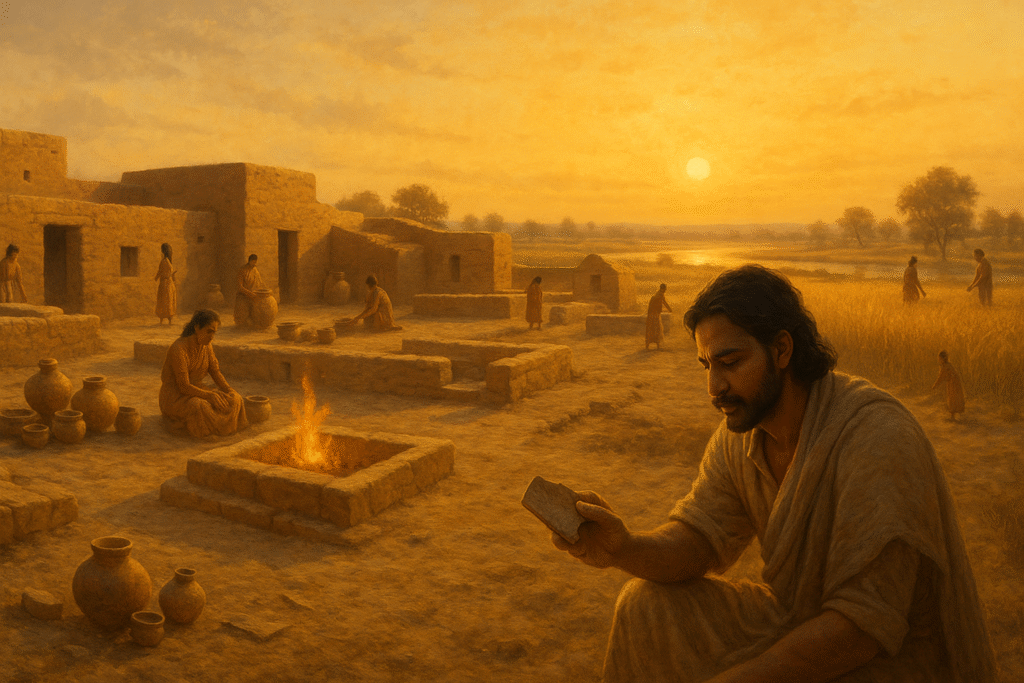
Archaeologists uncovered mud-brick houses, fire altars, standardized weights, and drainage systems—centuries before Mesopotamia. Having seen similar layouts in Greece and Iraq, I can confirm that India’s innovations predate them by millennia.
Agriculture and Livelihood
The site revealed evidence of early wheat and barley farming. This matches what I saw in museum displays across Europe, except that India’s examples are older and better preserved.
Spiritual Continuity
Fire altars discovered here resemble Vedic rituals. For me, this was living proof that the Harappan and Vedic cultures were not separate but one continuous tradition.
Challenging Colonial Narratives
When I compared my visits to Mesopotamia with my experience in Bhirrana, the contrast was striking. Textbooks still call Mesopotamia the “cradle of civilization,” yet Bhirrana’s antiquity disproves this claim.
My Reflection
Standing at Bhirrana, I realized: this soil holds answers to questions the world is still asking. The Aryan invasion theory collapses here. Civilization’s dawn was not in Mesopotamia—it was in Bharat.
 Bhirrana is not just an archaeological site—it is the first heartbeat of human civilization, still echoing in today’s India.

www.gloriesofindia.info | www.dineshrawat.live | www.greenmall.in | www.prakritibandhu.org