

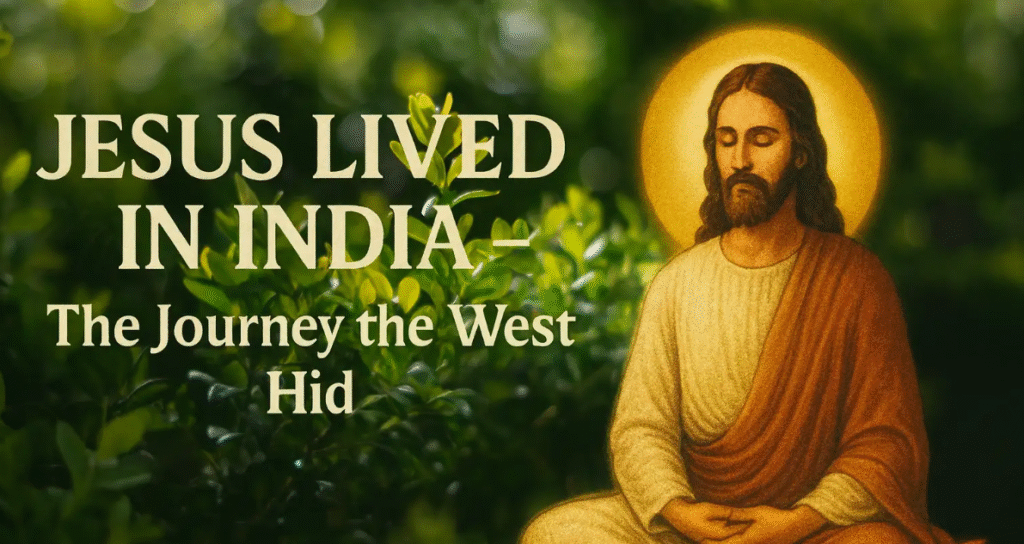
DID JESUS COME TO INDIA
DID JESUS COME TO INDIA
For centuries, the Church claimed Jesus vanished from age 13 to 30. But ancient scrolls, Himalayan legends, and a forgotten tomb in Kashmir reveal another path. Was Christ a seeker of Indian wisdom? Explore what they never taught you in Bible class.
The Missing Years of Christ – A Mystery That Challenges History
For nearly 2,000 years, a haunting silence has surrounded the most formative years of Jesus Christ’s life—between the ages of 13 and 30. These years are missing from the Bible and unexplained by Church doctrine. Why this void? What was Jesus doing during this time?
A growing body of evidence points east—toward India. Here, amid the towering Himalayas, ancient scrolls, local legends, and a mysterious tomb in Kashmir converge to reveal a story far deeper than the gospels have ever told.
A Trail of Clues – From Judea to the Himalayas
As a historical explorer, I—Dinesh Rawat—traveled to over 60 countries and traced the spiritual footprints of many faiths. In 2013, I visited the Rozabal Shrine in Srinagar, believed by many to be the final resting place of Jesus, known in the East as Yuz Asaf. There, I met Dr. Fida Hassnain, a renowned historian who had spent decades researching this very connection. His words resonated with truth—and sparked a deeper quest in me.
The Buddhist monastery scrolls found in Hemis, Ladakh, spoke of a “saintly foreigner named Issa” who preached love, nonviolence, and spiritual discipline. These texts, studied by Russian traveler Nicolas Notovitch in the 19th century, mirror Jesus’s teachings—yet the Church never acknowledged them.
Teachings of Issa – Echoes of the Sermon on the Mount
The scrolls describe Issa (a name similar to “Isa” used for Jesus in the Quran) as a young man who traveled to India, learned the Vedas, lived among Jain monks, and debated Buddhist scholars. His teachings were astonishingly close to what we later hear from Jesus in Palestine.
He taught:
– “Serve the poor.”
– “Do not return evil with evil.”
– “Love your enemies.”
– “God resides in your heart.”
This wasn’t borrowed from Greek philosophy. These are the values rooted in Sanatan Dharma and Buddhist compassion. It is no surprise that Jesus found resonance in India—the land of sages, not swords.
Hemis Monastery – Silence in the Himalayas
In my travels to Ladakh, I personally visited the Hemis Monastery, the very place where Nicolas Notovitch had discovered ancient scrolls mentioning a saintly figure named Issa. When I humbly asked the Abbot about these scrolls, he smiled gently, offered blessings—but responded as if he knew nothing.
This silence was telling.
It wasn’t ignorance—it was a guarded stillness, perhaps bound by external pressure or concealed arrangements. Over the years, it has become increasingly clear that certain truths are being shielded, not out of disinterest, but likely due to a mix of political caution, religious diplomacy, and maybe… discreet rewards. Truth in these sacred spaces often whispers—not because it is weak, but because it has been muffled.
Rozabal – The Tomb They Don’t Want You to Talk About
In the Khanyar area of Srinagar, lies the Rozabal Shrine, guarded by caretakers who pass down oral histories about a prophet-like man buried there. The grave bears markings that resemble crucifixion wounds. The shrine was once open to the public, but after growing interest in the 1990s and early 2000s, it was quietly sealed—why the cover-up?
During my 2013 visit, I saw it with my own eyes and felt the quiet sacredness of the site. Dr. Fida Hassnain confided in me that every piece of evidence matched the Jesus-in-India theory, but global forces—particularly the Vatican—suppressed it to protect their constructed narrative.
My Personal Encounters – Across India and the World
This theory isn’t built on a whim. I have personally stood in the very places that Christ may have walked—Ladakh, Srinagar, Nalanda, Bodh Gaya, Varanasi, and South India. I’ve spoken to Buddhist monks in Thailand, spiritual scholars in Cambodia and Sri Lanka, and researchers in Israel and Egypt.
Each place whispered a truth that the West has refused to hear: India was not just a stop—it was the sanctuary where Jesus evolved into the Messiah.
Why the West Buried the Truth
Accepting that Jesus studied in India would mean admitting that:
– Christianity owes its roots to Indian spirituality
– The Church cannot monopolize salvation
– Eastern wisdom predates Biblical teachings
And so, this truth was erased—through burned scrolls, rejected manuscripts, and discredited researchers.
Rising Above the Distortion
But the truth finds its way back—through seekers, travelers, and researchers like myself. My journey from Rameswaram to Jaffna, from Puri to Pyramids, was not just physical. It was a pilgrimage of rediscovering what connects all humanity—the divine light.
A Call to the Reader
If Jesus lived in India, what does that mean for us today?
It means religions must stop competing and start understanding.
It means India’s forgotten contribution to global spirituality must be restored.
And it means you must become a part of this rediscovery.
A Study by Green Guru Dinesh Rawat, Environmentalist, Researcher & Author
Websites: www.gloriesofindia.info | www.dineshrawat.live | www.greenmall.in | www.prakritibandhu.org