

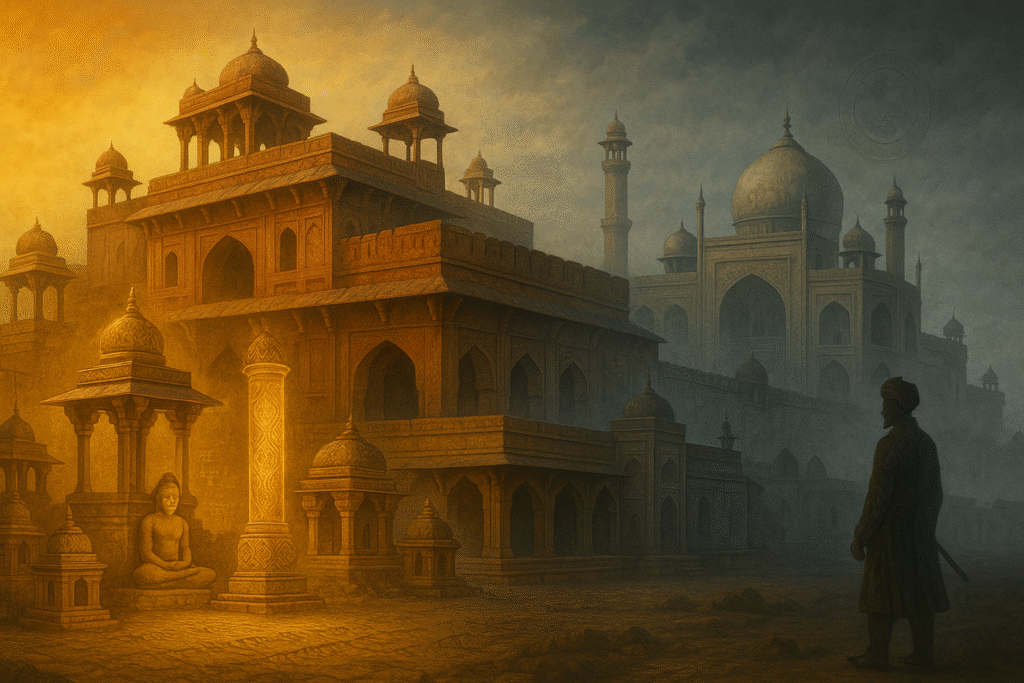
Akbar the Builder? Or the Usurper of Fatehpur Sikri?
- Ancient Jain and Hindu Temples
- Fatehpur Sikri was known as “Sikrigarh” and had flourishing Jain temples and Hindu shrines.
- A 12th-century Jain inscription was found near the fort, predating Akbar by centuries.
- The famous “Diwan-i-Khas” with its mysterious central pillar reflects Vedic or Jain cosmology, not Islamic design.
- Architectural Style
- The use of traditional Indian architectural elements, such as chhatris (domed kiosks), jalis (stone latticework), and mandapa-style pavilions, point to pre-Islamic Indian traditions.
- These styles contrast starkly with Mughal tomb architecture like Humayun’s Tomb or the later Taj Mahal.
- Etymology and Local Legends
- “Sikri” derives from “Shukri” or “Sanskriti”, meaning culture — linked to a flourishing spiritual center.
- Local folklore mentions the area being a center of learning and pilgrimage, long before Akbar arrived.
- Akbar’s Real Role?
- Akbar likely occupied and expanded the existing structures.
- As was common for Mughal rulers, he appropriated Indian heritage and claimed credit.
- He built walls, palaces, and mosques around the existing structures, projecting the illusion of founding a city.
 Why Would History Be Manipulated?
- Colonial British historians, like Vincent Smith, aimed to glorify Islamic rulers while downplaying India’s native dynasties and culture.
- This rewriting of history served a political narrative of disunity, pitting Hindu and Muslim communities against each other.
- The erasure of India’s architectural and spiritual legacy was part of a larger plan — similar to the Aryan Invasion and Darwinian Evolution theories.
 What Do Indian Texts Say?
- Hindu and Jain texts mention the region of Sikri as a center of sages and saints, with no mention of Akbar’s so-called foundation.
- It’s likely Akbar was told of its sacred power and attempted to leverage the spiritual energy of the area, hence shifting his court there.
 Final Thought The truth about Fatehpur Sikri is not just about bricks and domes — it’s about reclaiming India’s architectural glory and civilizational pride. Let’s correct the narrative: Akbar did not build Fatehpur Sikri; he repackaged ancient India for political prestige.