

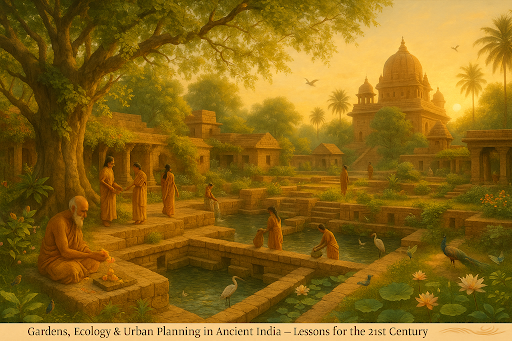
Gardens, Ecology & Urban Planning in Ancient India — Lessons for the 21st Century
The story of India’s civilization is not written only in temples and texts,
but in trees, tanks, and terraces — in how we lived with nature, not over her.
While the modern world struggles to “go green,” Bharat quietly reminds:
we have always been green.
The Sacred Idea of Nature
In the ancient Indian mind, nature was never an object to be used;
she was Prakṛti — the living embodiment of divinity.
The Rig Veda salutes her as Bhūmi Mātā — the Mother Earth
who nourishes all beings without discrimination.
The idea of ṛta — cosmic order —
was both moral and ecological:
to live in harmony with creation, conservation, and consciousness.
To harm nature was to disturb the very rhythm of existence.
This reverence shaped our gardens, our cities, and our souls.
Urban Planning Rooted in Ecology
Thousands of years before “sustainable cities” became a term,
the architects of the Saraswati–Sindhu civilization
were designing eco-balanced urban marvels.
At Dholavira, nine interconnected water reservoirs
and advanced drainage systems stored every drop of rain.
At Mohenjo-Daro, homes had private baths
connected to an underground citywide drainage grid.
Streets were aligned with wind direction for natural cooling,
and reservoirs served both ritual and functional purposes.
This was not engineering alone —
it was ecological spirituality in geometry.
Gardens as Living Philosophy
In India, gardens were never mere ornamentation;
they were spiritual diagrams of harmony.
From the lotus ponds of Nalanda to the palace gardens of Pataliputra,
plants were chosen for meaning —
the banyan for endurance, peepal for breath, neem for healing.
Texts like the Vāstu Shāstra and Bṛhat Saṃhitā
guided the layout of sacred gardens:
east for herbs, north for fruits, west for fragrance, south for shade.
Each was designed as a mandala —
a microcosm of balance between sunlight, water, and life.
Water — The Pulse of Civilization
India’s mastery of water systems is unmatched.
Stepwells like Rani-ki-Vav or Chand Baori
served as both architectural jewels and natural coolers.
Tanks, ponds, and canals connected entire towns,
recharging aquifers and regulating microclimates.
The Arthashastra codified water management
as a duty of statecraft — not charity.
Water was sacred, not scarce.
Every drop was gratitude materialized.
Sacred Groves — Ancient Biosphere Reserves
Long before the world coined “protected forests,”
India had Dev-Vans — sacred groves where no axe could fall.
These were early biosphere reserves,
preserving genetic diversity and spiritual humility.
Even kings bowed before them.
From Meghalaya’s Mawphlang to Kerala’s Kavu,
many such groves still breathe as green shrines
of India’s ecological conscience.
From Epics to Ecosystems
Our epics themselves are eco-texts.
Rāmāyaṇa is a pilgrimage through forests, rivers, and mountains —
where each landscape is a teacher.
Mahābhārata teaches dharma through cycles of life and loss —
its setting, too, a land of rivers and sacred groves.
For ancient India, to rule justly was to first learn nature’s rhythm.
Civilization meant coexistence, not conquest.
Science and Dharma in Soil
Ancient treatises like Vṛkṣāyurveda and Krishi-Parāśara
describe composting, mixed cropping, and natural pest control —
principles that modern science calls “organic farming.”
Our ancestors farmed without exhausting the land.
They built cities that breathed,
temples that harvested water,
and gardens that healed.
For them, the soil itself was a scripture —
a manuscript of dharma written in earth.
Reviving the Green Dharma
Today’s climate crisis is not new — it is a forgotten memory.
India once knew that to build was to balance,
to cultivate was to care.
Our sacred texts, stepwells, and groves
hold blueprints for a livable future.
Urban forests can be our new Dev-Vans.
Rooftop gardens can echo Nalanda’s courtyards.
Rainwater tanks can sing the science of Dholavira once again.
The future is ancient — if we remember.
Prakriti Mandir — The Living Revival
In this very spirit, Prakriti Mandir stands today
as a living homage to Bharat’s timeless ecological vision.
Founded within the Green Mall Campus near Kolkata,
it is not merely a place — it is a philosophy made visible.
Here, every tree, every pond, and every garden
is part of a spiritual architecture where ecology becomes devotion.
Prakriti Mandir revives the ancient Indian principle
that to worship nature is to protect her.
Its green corridors, sacred groves, and educational gardens
carry forward the dharmic ideal of Prakṛti Seva —
the service of nature as the service of the Divine.
The Music of the Earth — Prakriti Ki Pukar & Prakriti Vandana
To awaken this ancient harmony in modern hearts,
two soulful musical albums were created —
“Prakriti Ki Pukar” (The Call of Nature) and “Prakriti Vandana” (The Hymn to Nature).
Each song is an invocation, blending environmental awareness
with the serenity of India’s spiritual melodies.
Prakriti Ki Pukar urges humanity to listen again
to the rivers and the winds —
to hear the planet’s gentle voice asking for care.
Prakriti Vandana celebrates the eternal rhythm
between man and nature — a rhythm that once sustained civilizations.
Together, they are the soundtrack of a renaissance —
the same message that once echoed through India’s ancient forests
now returning as music for the modern mind.
Conclusion — The Eternal Garden
Ancient India designed not cities, but ecosystems of the soul.
Its architects were gardeners, its priests were ecologists,
its temples were schools of sustainability.
That same legacy blooms today in every initiative
that honors the green dharma —
from sacred groves to Prakriti Mandir,
from ancient hymns to modern songs of the earth.
“When the hand plants a tree and the heart sings to it,
Bharat’s civilization breathes again.”