

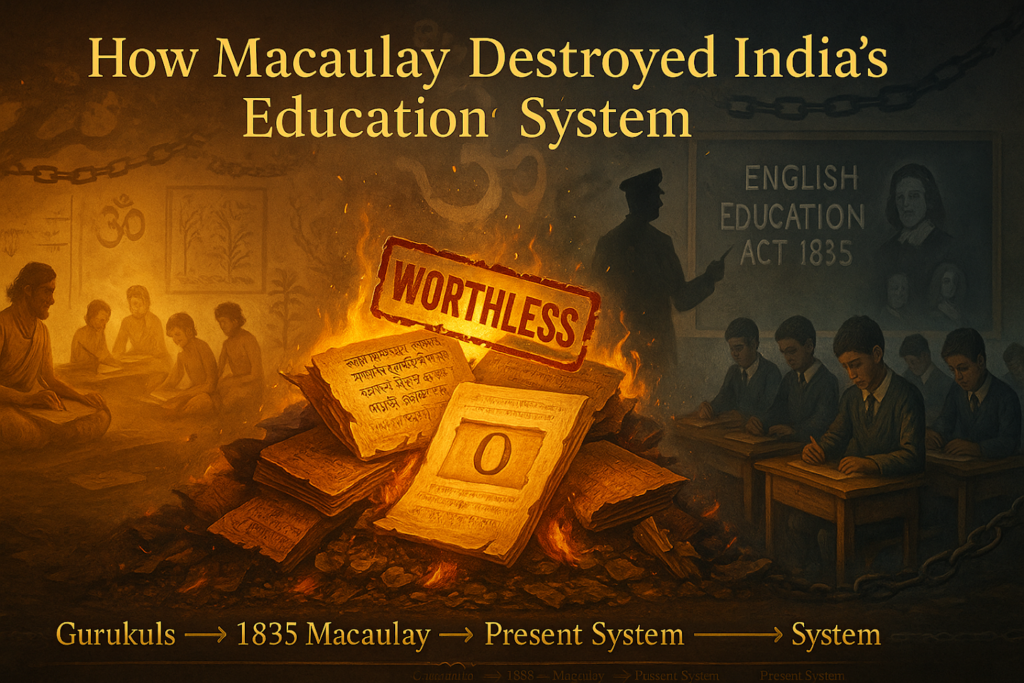
In the 19th century, while India remained a land of flourishing traditions, languages, sciences, and spirituality, a silent war was launched—not with cannons or swords, but with chalk and curriculum.
That war was led by a man named Lord Thomas Babington Macaulay.
The Speech That Shook India’s Foundations
On February 2, 1835, Macaulay stood in the British Parliament and declared:
“I have travelled across the length and breadth of India and I have not seen one person who is a beggar or who is a thief… Unless we break the very backbone of this nation, which is her spiritual and cultural heritage…”
He went on to propose a strategy more dangerous than any battlefield plan — destroy India’s indigenous education system and replace it with a British one. His logic? If Indians were taught to believe that their language, their heritage, and their wisdom were inferior, they would willingly become subjects—not just of the British Crown, but of the British mind.
And that’s exactly what happened.
The Death of India’s Gurukuls and Native Knowledge
Before Macaulay’s intervention, India had a robust network of Gurukuls, madrasas, pathshalas, and ashrams where students studied mathematics, astronomy, medicine, logic, ethics, literature, and spirituality. These were centers of enlightenment, many of them teaching in Sanskrit, Tamil, Bengali, Persian, Arabic, and other native languages.
Macaulay called this system “worthless” and advocated for a class of Indians who would be Indian in blood, but English in taste, opinions, morals, and intellect. The aim was clear: mental colonization.
This led to:
- Closure of thousands of traditional schools.
- Loss of countless ancient manuscripts.
- Devaluation of Sanskrit, Pali, and other native languages.
- Promotion of a foreign culture as superior.
Cultural Amnesia: A Generation Cut from Its Roots
This was not just an education policy—it was cultural erasure.
Generations grew up with no knowledge of their ancestors’ greatness, taught to look at their own traditions with shame. Ancient wisdom was dismissed as superstition, and the English way of life was hailed as “modern.” A proud civilization, which had given the world yoga, zero, Ayurveda, metallurgy, and profound spiritual philosophies, was made to forget its identity.
The result? A fractured society. A nation with brilliant minds—but with borrowed confidence and imported standards.
The Long-Term Damage
Even today, the impact of Macaulay’s strategy is visible:
- We judge success by how well we speak English, not by how well we understand ourselves.
- Our education system largely ignores Indian philosophy, culture, and history.
- Many Indians know Shakespeare better than Kalidasa, Newton better than Aryabhata.
Macaulay didn’t just introduce English; he replaced self-respect with self-doubt.
The Revival Has Begun — But It’s Not Over
In recent decades, there’s been a growing movement to reclaim Indian knowledge systems, from Ayurvedic medicine to Vedic mathematics, from Sanskrit revival to indigenous history. But the scars run deep, and healing requires awareness, pride, and action.
We must unlearn the lie that our past was dark and backward. Because no nation can rise without knowing where it came from.
Final Thought
Lord Macaulay didn’t need to enslave a billion people with chains.
He did it with a pen.
But today, the pen is in our hands. Let’s write a different future — rooted in truth, pride, and ancient wisdom.
www.gloriesofindia.info | www.dineshrawat.live | www.greenmall.in | www.prakritibandhu.org