India – The Source Civilization: Evident from Global Migration Patterns
A Vedic Trail Across Continents
For centuries, Western historians have presented Mesopotamia, Sumer, or Egypt as the “cradles of civilization.” But what if the true source of civilization lies deeper, older, and further East—in India? What if the Vedic civilization, with its profound knowledge, spiritual wisdom, and societal systems, was not an isolated phenomenon but the fountainhead of global human migration and culture?
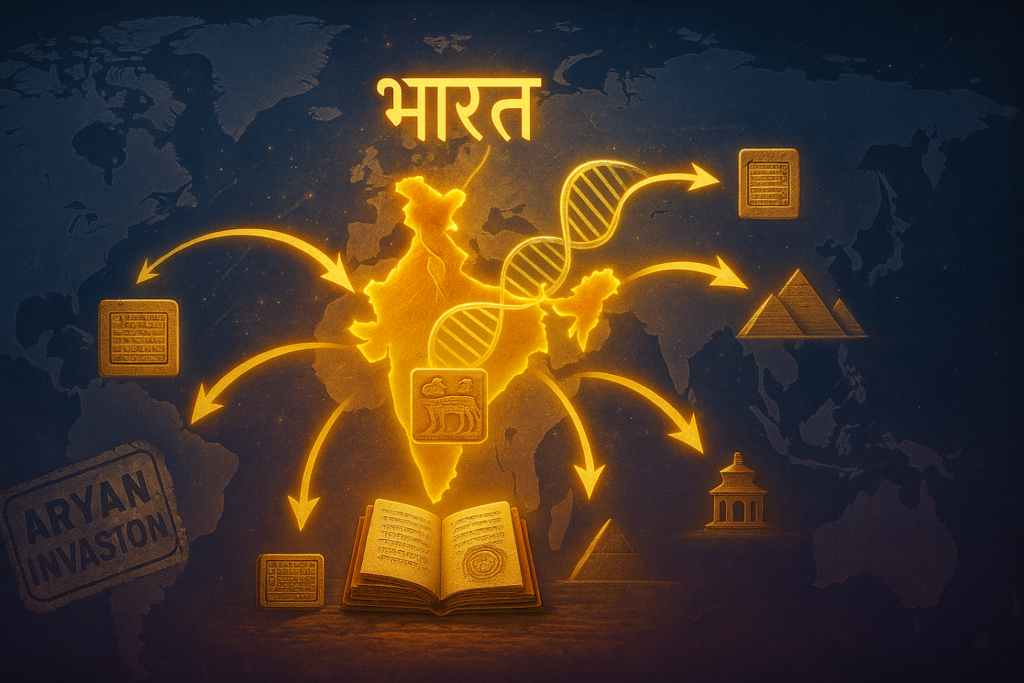
This blog explores compelling genetic, archaeological, linguistic, and cultural evidence that suggests India was not a recipient but the originator of civilization—and that people migrated out of India, not into it.
 1. Genetics Debunk the Aryan Invasion Myth
Modern genetic studies have overturned the colonial Aryan Invasion Theory, which claimed that fair-skinned invaders brought civilization into India around 1500 BCE.
Key discoveries:
- The Rakhigarhi DNA study (2019) revealed no traces of “steppe ancestry,” disproving the idea of an invading Aryan race.
- Indian populations show a genetic continuity for over 10,000 years, linking ancient Harappan people with today’s Indians.
- The Out of India Theory (OIT) is now gaining scientific support: Vedic people migrated from India westward, influencing Mesopotamia, Iran, and even Europe.
India wasn’t invaded into civilization—it spread civilization outward.
 2. Archaeology: India’s Cities Are the Oldest
- Bhirrana in Haryana is now considered the oldest known urban site, dating back to 7380 BCE, older than any Mesopotamian city.
- Rakhigarhi, Kalibangan, and Lothal reveal advanced town planning, water systems, fire altars, and metallurgy—signs of a mature, spiritual, and organized civilization.
- These cities flourished long before the Egyptian pyramids or Sumerian cuneiform.
Archaeology confirms: India’s civilization predates and surpasses the so-called Western cradles.
 3. Linguistic Traces of Sanskrit Across the World
Sanskrit, the language of the Vedas, is not just ancient—it’s foundational to many world languages.
Examples:
- Latin, Greek, and Persian share deep linguistic roots with Sanskrit (all part of the Indo-European family).
- Words like mother, father, man, name, navy, and star closely resemble their Sanskrit counterparts: matṛ, pitṛ, manuṣya, nāma, nau, tārā.
- Even Mayan and Polynesian cultures have Sanskrit-like words and rituals.
This suggests not borrowing, but migrating language and culture from India to distant lands.
 4. Shared Myths, Deities, and Symbols
Cultures across the globe share astonishing parallels with Vedic tradition:
- Flood myths in Mesopotamia and Greece resemble Manu’s story from the Vedas.
- The Egyptian Shiva-like figures, Sumerian fire altars, and Zoroastrian Agni worship all echo Vedic rituals.
- The Swastika, a sacred Vedic symbol, is found in Native American, European, and Asian civilizations—predating Nazi misuse.
Such deep spiritual parallels could only exist if the source culture (Vedic India) once touched all these lands.
 5. Temples and Astronomical Alignments Worldwide
- Angkor Wat in Cambodia is dedicated to Vishnu, and its layout reflects Vedic cosmology.
- Megalithic sites like Stonehenge, Machu Picchu, and the Pyramids have astronomical precision that mirrors ancient Indian temple alignments.
- Kailasa Temple, carved from a single rock, predates most world structures and defies modern explanation.
The architectural genius of ancient India inspired spiritual architecture globally.
 6. Vedic Knowledge in Indigenous Cultures
- Native American tribes speak of cosmic cycles, karma, and reincarnation.
- Inca, Maori, and Aboriginal traditions revere sun worship, om-like sounds, and sacred rivers.
- Ancient Chinese medicine and Taoist breathwork bear remarkable similarity to Ayurveda and Pranayama.
These are not coincidences—they are cultural memories of Vedic migration.
 7. Global Migration Routes – Out of India
- The Saraswati-Sindhu region was not only fertile, it was the launchpad for migration.
- Vedic people migrated:
- Westward → Mesopotamia, Persia, Egypt, Europe
- Eastward → Southeast Asia, China, Indonesia
- Southward → Sri Lanka, Africa
- Northward → Central Asia, Russia
Even Roma gypsies of Europe trace their roots to India. Their language, customs, and genes all point homeward.
 8. India’s Culture Never Invaded – It Attracted
Unlike Western empires that spread by war, Indian civilization spread through wisdom, trade, and spirituality.
- Buddhist monks journeyed peacefully from India to China, Japan, Tibet.
- Hindu temples and Vedic texts reached Bali, Cambodia, and Thailand—not by sword, but by respect and reverence.
- Even Islamic mystics in India were influenced by yogic and Vedantic thought.
This is the hallmark of a Source Civilization—one that radiates, not dominates.
 9. Western Scholars Who Acknowledged India
Many great minds from the West quietly admitted India’s primacy:
- Voltaire: “Everything has come down to us from the banks of the Ganges.”
- Will Durant: “India was the mother of our race and Sanskrit the mother of Europe’s languages.”
- Mark Twain: “India is the cradle of the human race, the birthplace of human speech…”
Yet, colonial academia buried these truths. The time has come to resurrect them with pride.
 10. Reclaiming the Grand Narrative
India is not just a spiritual center—it is the civilizational seed of the world.
- The Vedas, Upanishads, and Mahabharata are not myths, but historical and cultural blueprints.
- The world must not forget, and India must not remain silent.
- It is time to rewrite history books, re-educate youth, and reclaim the honor due to Bharatvarsha.
 Conclusion: From One Light, Many Lamps
From India’s eternal flame, civilizations across continents have been lit. The Vedic worldview—rooted in dharma, truth, cosmic order, and harmony with nature—was never local. It was always universal.
We are not one among many ancient cultures.
We are the source.
The Adi-Sanskriti.
The original light that inspired the world.
Let this truth rise again.
A Study by Green Guru Dinesh Rawat, Environmentalist, Researcher & Author www.gloriesofindia.info | www.dineshrawat.live | www.greenmall.in | www.prakritibandhu.org YouTube: @Glories-of-India
 WhatsApp: +91 7278006663