

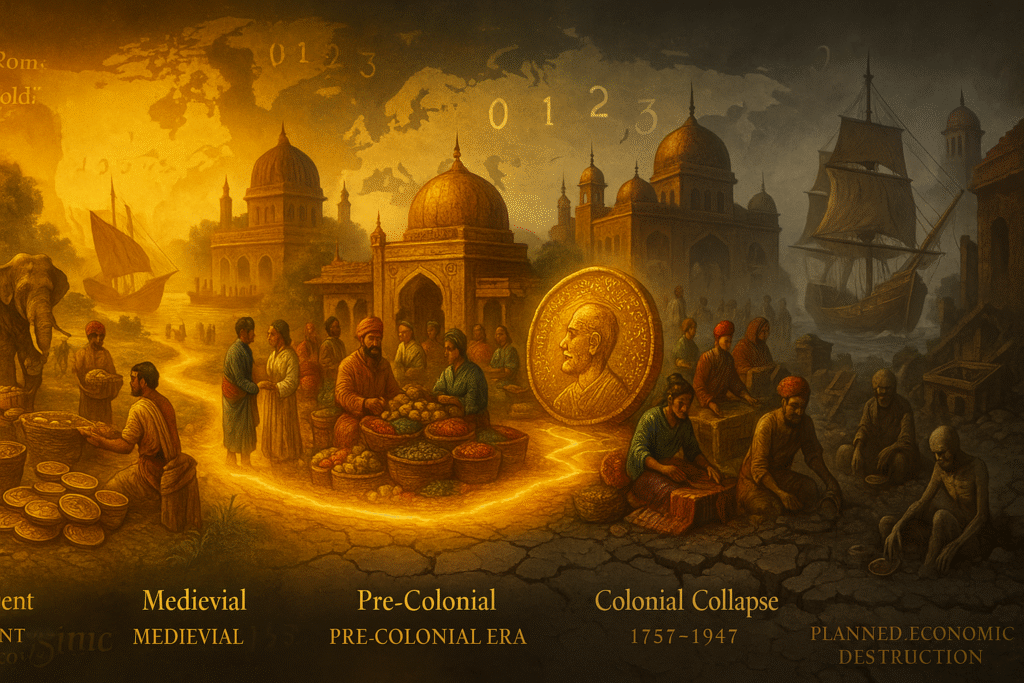
India: The Wealthiest Civilization the World Ever Knew – Until 200 Years Ago
 A Forgotten Legacy of Prosperity
For over two millennia, India stood as the economic superpower of the world. It wasn’t just rich—it was the richest, with a vast share of global GDP, flourishing industries, vibrant trade routes, and intellectual mastery that inspired the world.
But in just the last 200 years, that legacy was decimated by foreign invasions, colonial exploitation, and a rewritten narrative.
Let us uncover the truth in numbers, and reclaim the pride of India’s glorious past.
 Source: Angus Maddison (World Economy: A Millennial Perspective, OECD)
 Note: Maddison’s work is widely cited but conservative. Other estimates suggest India’s wealth could’ve been even higher.
 1. Ancient India – Land of Abundance and Order
As early as 1st century CE, under the Satavahanas and Kushans, India’s economy was thriving with:
- Vast agricultural output (supported by monsoons and irrigation)
- Vibrant trade routes with Rome, Arabia, and China
- Use of gold and silver coins
- Large-scale urbanization and manufacturing
➤ Roman historian Pliny the Elder lamented:
“India drains Rome of her gold.”
 2. Medieval India – Still the World’s Leader
In 1000 CE, while Europe was in the Dark Ages:
- India’s GDP was nearly 30% of the world’s total.
- Universities like Nalanda and Odantapuri were international hubs.
- Spices, gemstones, iron and steel (like Wootz) were exported globally.
- The Cholas extended naval and trade power into Southeast Asia.
 3. Pre-Colonial Era – A Treasure Everyone Wanted
By 1700, under the Mughal Empire:
- India had 24.4% of the global economy.
- Cities like Agra, Lahore, Delhi, Surat, and Murshidabad were bustling centers of wealth.
- The Mughal minting system produced gold coins of extraordinary purity.
- Handcrafted textiles, carpets, weaponry, perfumes, and jewelry were sought after from Persia to Portugal.
 4. The Colonial Collapse (1757–1947)
 The East India Company Era:
- After Plassey (1757), British economic policies began transferring wealth to Britain.
- Famines increased, Indian industries declined.
- By 1820, India’s share dropped to 16%.
By 1947:
- India was reduced to 3.8% of world GDP
- Literacy was under 15%
- Life expectancy was below 40 years
- Industrial output shrunk to <2% of British imports
This was not a natural decline—it was a planned economic destruction.
 5. What Made India So Wealthy?
- Geography: Access to sea trade, rich mineral deposits, and fertile lands
- Scientific Innovation: Metallurgy, mathematics, medicine, astronomy
- Cottage Industries: World-class handloom, pottery, sculpture, and weaving
- Temples as Banks: Stored gold, acted as community welfare centers
- Spiritual Capital: Peace, prosperity, and Dharma-based governance attracted global seekers
 6. Foreign Accounts That Praise India’s Wealth
- Marco Polo (1292): Southern India had pearls, silk, rubies, spices in abundance
- Ibn Battuta (1334): Described Indian cities as “larger and more populous than any in the Islamic world”
- Al-Biruni (1030): Amazed at India’s knowledge and self-sufficiency
- British records (1800s): Acknowledge India’s wealth in trade, resources, and intellect
 7. Why the British Targeted India First
India’s:
- Location (connects East and West trade)
- Vast gold, diamond, and spice wealth
- Highly skilled artisan population
- Wealthy temples and cities
…made it the most lucrative prize on Earth.
“India is the pivot of our Empire… If the Empire loses India, it falls.” — Lord Curzon, 1900
 8. What Was Lost – And What Remains
India lost:
- Thousands of years of accumulated wealth
- Her global economic status
- Knowledge systems mocked and sidelined
Yet, we preserved:
- Our spiritual integrity
- Our resilience
- Our civilizational wisdom
 9. Time to Reclaim – Not Just Remember
Let us stop seeing ourselves as a “developing nation” and start recognizing that:
India was the richest, the wisest, and the most sought-after land on Earth for 2000 years.
This pride is not ego—it is identity.
 Conclusion: India’s Wealth Was No Myth
From 1 CE to 1700 CE, India dominated global wealth and innovation. Colonialism didn’t “develop” India—it depleted her. The real story is of India’s rise, resilience, and the systematic theft that followed.
Let us tell this story to our children—not as a tale of victimhood, but as a call to reclaim our ancient glory with modern strength.
“A Study by Green Guru Dinesh Rawat, Environmentalist, Researcher & Author”
www.gloriesofindia.info | www.dineshrawat.live | www.greenmall.in | www.prakritibandhu.org