

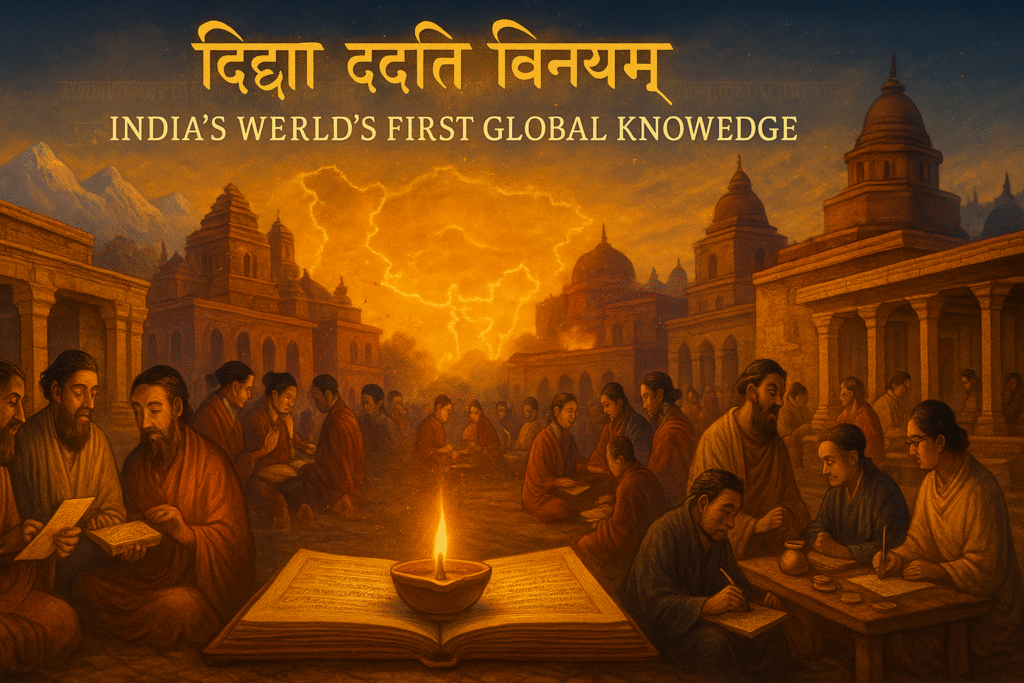
Introduction: The World Once Came to Learn From India
Long before Oxford, Cambridge, or Harvard were conceived, India was the global capital of knowledge. From the snow-capped Himalayas to the shores of Kanyakumari, this land nurtured not just temples—but universities, thinkers, scientists, physicians, and philosophers.
Students from China, Korea, Tibet, Arabia, and even Europe traveled thousands of miles to study in India’s ancient universities—places where Sanskrit echoed through courtyards, and where logic, medicine, mathematics, and metaphysics were taught alongside spirituality.
This blog uncovers the forgotten glory of India’s university system—a civilizational achievement that was later destroyed by invasions and colonization, but not before lighting the lamps of knowledge across the ancient world.
 1. India’s Vision of Education – Holistic, Spiritual, Scientific
Education in Bharat was not job-oriented—it was self-realization-oriented.
- Learning was guru-centered, not degree-centered.
- Students (shishyas) lived in gurukuls, where character-building, discipline, and simplicity were central.
- Emphasis was on Shruti (listening), Smriti (remembering), Manan (reflection) and Nidhidhyasan (meditation).
- Subjects taught included:
- Vedas, Vedanta, Sanskrit, Nyaya (logic), Ayurveda, Jyotisha (astronomy), Ganita (math), Arthashastra (economics), Shilpa (architecture), Dhanurveda (warfare), and more.
India educated not just scholars—but rishis, seers, yogis, surgeons, poets, philosophers, and strategists.
 2. Takshashila – The World’s First Known University (6th Century BCE)
 Location: Present-day Pakistan
 Established by: Taksha, son of Bharata (Ramayana era)
 Students: Over 10,000
 Teachers: Around 2000
 International students from: China, Greece, Arabia, Sri Lanka, Central Asia
- Subjects:
- Vedas, Sanskrit, Ayurveda, Surgery (Shalya Tantra)
- Mathematics, Astronomy, Logic, Philosophy
- Law, Political Science, Economics, Grammar (Panini taught here)
Legendary scholars like Panini (grammarian), Charaka (physician), and Chanakya (economist) were associated with Takshashila.
It was a multi-disciplinary, global university functioning 2,000 years before the first European university.
 3. Nalanda University – The Crown Jewel of Global Learning (5th–12th Century CE)
- Location: Bihar, India
- Built by: Gupta emperor Kumaragupta I
-
 Students: Over 12,000, including monks from Asia
 - Teachers: 2,000+ monks and acharyas
 Attracted students from: Tibet, China, Korea, Sumatra, Java, Sri Lanka
- Curriculum:
- Mahayana and Hinayana Buddhism
- Logic, Sanskrit grammar, Philosophy
- Medicine, Mathematics, Fine Arts, Astrology
Library: Dharma Gunj (Mountain of Truth)
- 9 million manuscripts across 3 buildings
- Burned for months by Bakhtiyar Khilji in 1193 CE
Chinese traveler Xuanzang, who studied there for 5 years, wrote that no other center in the world matched Nalanda’s standards.
 4. Vikramashila – The Tantric and Logical Powerhouse
- Location: Bhagalpur, Bihar
- Established: 8th Century CE by King Dharmapala (Pala dynasty)
- Students: ~8,000
- Teachers: ~1000
- Specializations:
- Tantric Buddhism, Logic, Debate, Sanskrit Grammar
- Meditation practices and metaphysics
 108 temples and a great stupa
- Links with Nalanda—students often graduated from one to enter the other
It was especially respected in Tibetan Vajrayana traditions, and its monks were regularly invited by foreign courts.
 5. Vallabhi University – Gujarat’s Forgotten Intellectual Gem
- Location: Vallabhi, Saurashtra (Gujarat)
- Timeline: 6th–12th Century CE
- Students: Over 6,000
- Curriculum:
- Administration, Commerce, Political Science, Law
- Vedas, Logic, Buddhist philosophy (mainly Hinayana)
- Praised by: Chinese monk Itsing, who called it “a rival to Nalanda”
It was practical and secular, producing excellent public administrators and scholars.
Many of these were temple-based universities, supported by kings, merchants, and communities.
 7. Who Destroyed India’s Education System?
 Islamic Invaders (8th–12th Century)
- Targeted temples and universities
- Bakhtiyar Khilji destroyed Nalanda, Vikramashila, Odantapuri
- Monks were burnt alive, libraries set on fire
- Priceless knowledge vanished—a civilizational massacre

 British Colonial Strategy (18th–20th Century)
- Macaulay’s 1835 policy aimed to produce “brown Englishmen”
- Sanskrit, regional sciences, Ayurveda were deemed useless
- Gurukuls, pathshalas, and community schools lost patronage
- Over 100,000+ schools, as reported in William Adam Report, were ignored
British replaced self-discovery with servitude—education became a means to produce clerks, not thinkers.
 8. What Made Indian Education Unique?
 No fees – Education was considered a sacred duty, not a business Teacher-student bond – Gurus were spiritual guides Balance of science and spirit – Math, surgery, and astronomy taught alongside meditation and ethics Decentralized system – Learning flourished in every village, not just urban centers Inclusivity – Women like Gargi, Maitreyi, and Lopamudra were celebrated Vedic scholars
 Conclusion: From Vishwa Guru to Forgotten Teacher – And Back Again
India once taught the world. Its scholars mapped the stars, measured atoms, debated dharma, and guided empires—without ever invading anyone.
But invasions destroyed its institutions, and colonialism corrupted its narrative.
Today, as India reclaims its spiritual, cultural, and technological place in the world, it must also reclaim its educational model—rooted in Sanatan wisdom, scientific inquiry, and character-building.
Let the flame of Nalanda burn again.
Let Bharat become the Vishwa Guru, not just in name—but in truth.
“A Study by Green Guru Dinesh Rawat, Environmentalist, Researcher & Author”
www.gloriesofindia.info | www.dineshrawat.live | www.greenmall.in | www.prakritibandhu.org