

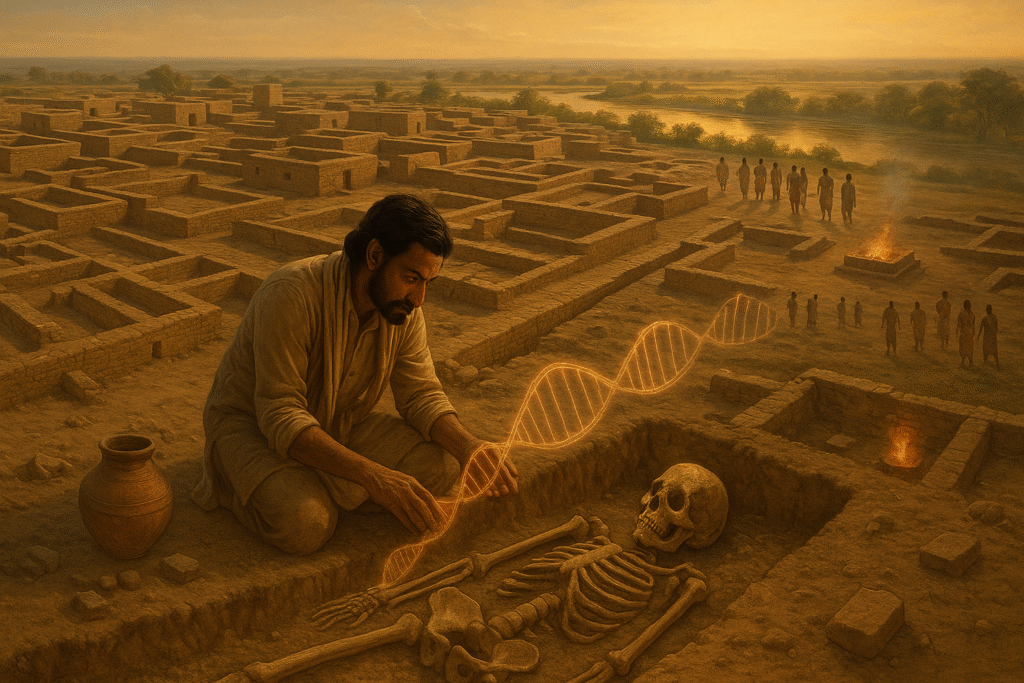
Rakhigarhi: DNA of Continuity – My Journey into the Living Past
Over the last 35 years, I have traveled to 60 countries, studying civilizations firsthand. From Egyptian tombs to Mesopotamian temples, I have seen humanity’s heritage. Yet, in Rakhigarhi (Haryana, India), I encountered something unique—a direct genetic link between the ancient Harappans and today’s Indians.
Largest Harappan Site
Rakhigarhi is the largest Harappan site ever discovered, bigger than Mohenjodaro. When I walked its ancient lanes, I could imagine life thriving here 5000 years ago—streets, pottery workshops, drainage, and granaries.
The DNA Breakthrough
In 2019, scientists extracted DNA from a woman’s skeleton found at Rakhigarhi. The results were groundbreaking:
- Harappans had no Central Asian steppe ancestry.
- Their DNA matches modern Indians, showing unbroken continuity.
As someone who has compared artifacts globally, this discovery struck me personally—it demolishes the Aryan Invasion Theory, a colonial myth that divided India.
Spiritual and Cultural Links
Fire altars found here reminded me of Kalibangan, aligning with Vedic traditions. Ritual continuity, combined with DNA proof, makes Rakhigarhi the strongest evidence that Harappans are our ancestors.
My Reflection
Standing in Rakhigarhi, I realized: history isn’t broken, it flows like the Saraswati river nearby. Unlike Mesopotamia and Egypt, which saw collapse, Bharat’s civilization has continued unbroken for 10,000 years.
 Rakhigarhi is not just an excavation—it is our mirror across millennia.

www.gloriesofindia.info | www.dineshrawat.live | www.greenmall.in | www.prakritibandhu.org