

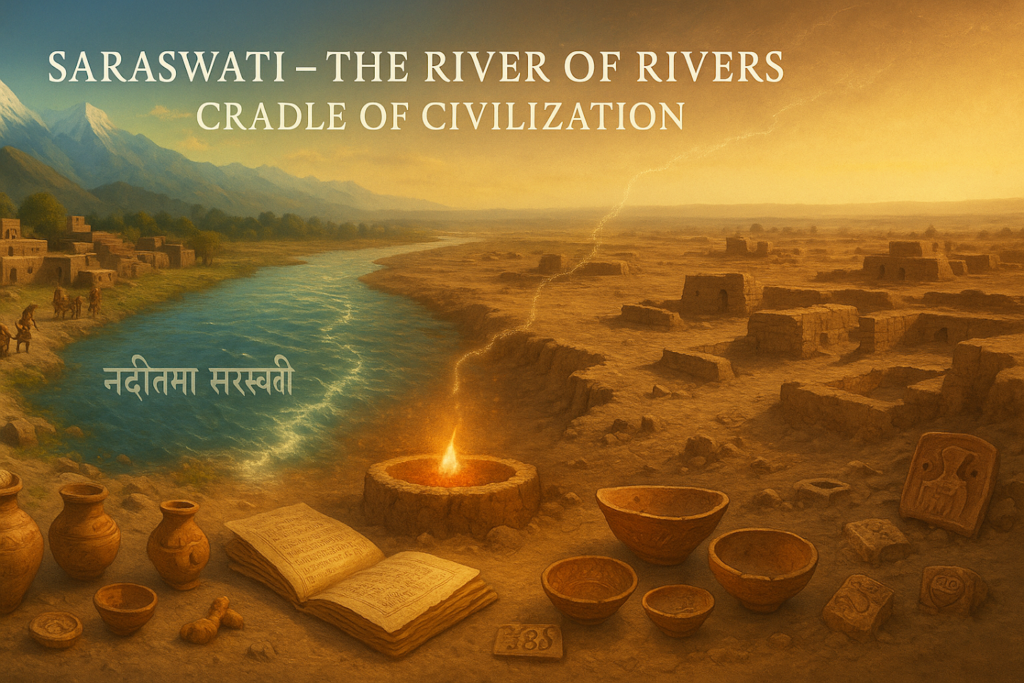
In the Rigveda, the Saraswati is praised as the “river of rivers,” flowing mightily from the mountains to the sea. For centuries, many dismissed it as a myth — a poetic imagination of ancient seers. Yet, modern science has begun to confirm what tradition always knew: the Saraswati was real, powerful, and central to India’s civilization.
Satellite imagery, geological surveys, and archaeological digs reveal the course of a massive river once flowing parallel to the Indus, stretching from the Himalayas through Haryana and Rajasthan to the Rann of Kutch. This river began to dry up around 1900 BCE due to tectonic shifts and climate changes. Yet, Vedic hymns describe it in full flow — which means the Rigveda must predate this drying. If so, India’s sacred texts are far older than colonial timelines suggest.
The Saraswati story unsettles more than dates. It rewrites civilizational geography. Thousands of Harappan sites lie along its dry bed, suggesting the so-called “Indus Valley Civilization” should rightly be called the “Saraswati Civilization.” This changes India’s historical map from a peripheral Indus-based culture to a Saraswati-centered one.
It also rewrites memory. Though the river dried, India never forgot it. Even today, villages in Rajasthan and Haryana hold fairs on its invisible banks. Pilgrims worship Saraswati at the Triveni Sangam in Prayagraj, though the river is unseen. This cultural continuity is evidence of India’s extraordinary civilizational memory, where physical absence did not erase spiritual presence.
Why does this matter today? Because history is not just about the past; it shapes identity. When textbooks tell students that Saraswati is a myth, they teach them to distrust their own heritage. But when science validates Saraswati, it shows that India’s memory is not fantasy but evidence. It gives confidence that other dismissed traditions — Dwarka, Rama Setu, astronomical references in epics — deserve equal study.
The Saraswati river is more than water. It is a symbol of India’s resilience, memory, and continuity. To acknowledge it is to honor a civilization that has endured for millennia. In the end, Saraswati teaches us this: rivers may vanish, but truth flows eternally.

www.gloriesofindia.info | www.dineshrawat.live | www.greenmall.in | www.prakritibandhu.org