Introduction: A Political Freedom, Not a Civilizational Liberation
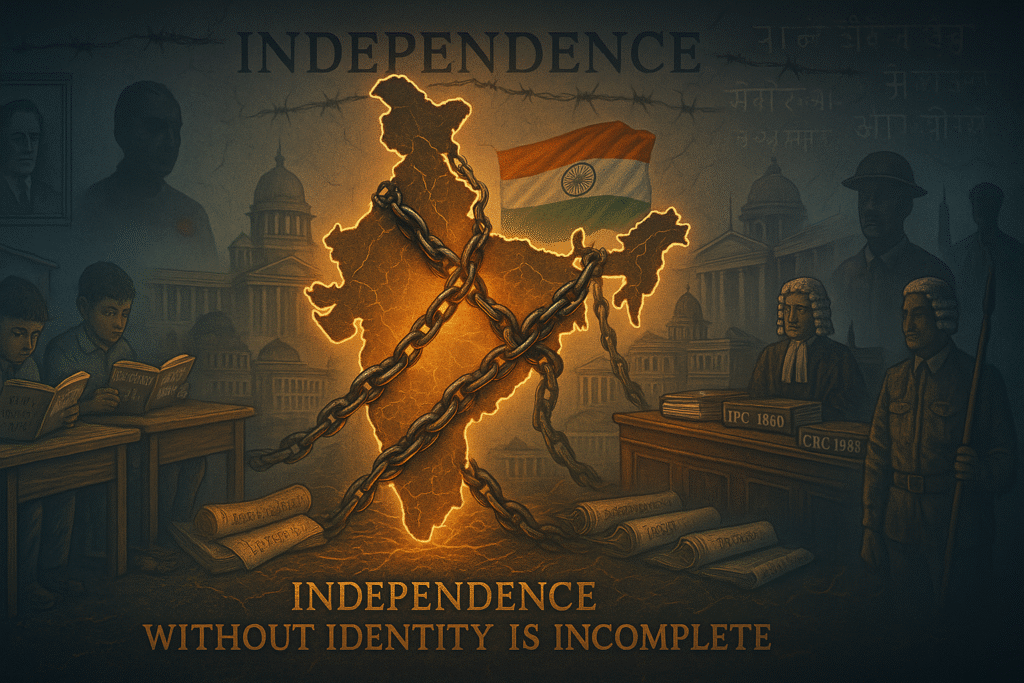
India may have unshackled the chains of British political rule in 1947, but did it truly gain independence?
While the Union Jack was lowered, the deeper colonial mindset remained intact.
The structures, the education, the economy, even the historical narratives—all continued on the same Western blueprint.
Why? Because those who took charge of the nation post-1947 didn’t challenge the colonial foundation.
Instead, they preserved, protected, and propagated it—sometimes consciously, often blindly.
 1. Continuation of Colonial Education – Macaulay Lives On
One of the biggest betrayals was in the field of education.
Despite heartfelt appeals from thinkers like Sri Aurobindo, Dharampal, and Mahatma Gandhi, the government retained:
- Macaulay’s English-centric system
- Syllabi written by colonial and Leftist historians
- An education model that divorced youth from Indian culture, languages, and dharma
 The result?
An entire generation grew up thinking India was backward until the British came.
Sanskrit was forgotten, Vedas were mocked, and Mughal invaders were glorified.
 2. Nehru’s Western Obsession – A Globalist in a Desi Cloak
Pandit Nehru, the first Prime Minister, admired British institutions, Fabian socialism, and Western rationalism.
While he had emotional love for India, he was deeply conditioned to believe:
“Ancient India = mysticism and stagnation.
Modernity = Western science and secularism.”
 Under his vision:
- Indian knowledge systems like Ayurveda, Jyotish, and Yoga were marginalized
- IITs and IIMs were promoted, but with Western syllabi
- Even the Indian Constitution was borrowed, not built on Dharma Shastras or Panchayat traditions
 3. Historical Lies Were Never Corrected
Post-1947, no serious attempt was made to rewrite Indian history based on archaeological, genetic, or indigenous sources.
Instead:
- British distortions like the Aryan Invasion Theory were kept intact
- Historians like R.C. Majumdar and P.N. Oak were sidelined
- Mughal atrocities were omitted; instead, they were glorified as nation builders
- Christian missionary narratives on “barbaric India” remained unchallenged
 The Indian Council of Historical Research (ICHR), dominated by Marxist historians, strengthened colonial lies instead of reversing them.
 4. Sanskrit and Indian Languages Were Neglected
Instead of reviving Sanskrit and making it the national language, the rulers chose:
- Hindi-English compromise that led to decades of confusion
- Neglect of classical texts, shastras, and Vedic literature
- Promotion of English-medium elitism over mother-tongue wisdom
 India, the land of the world’s oldest language, chose to be educated in the colonizer’s tongue.
 5. Colonial Laws and Legal System Retained
India’s policing and legal system remained largely unchanged post-independence:
- Indian Penal Code (IPC) and Criminal Procedure Code (CrPC)—both British-made—were retained
- Police system remained authoritarian, not citizen-centric
- Justice system became slow, expensive, and alien to Indian values
Even today, Indian courtrooms operate in English, with archaic wigs and gowns—a colonial theatre still running.
 6. Temple Control Continued – But Churches and Mosques Were Freed
Astonishingly, Hindu temples were nationalized and taken over by state governments:
- Their funds, rituals, appointments—all under bureaucratic control
- Yet, churches and mosques remained untouched, enjoying full freedom
 This unequal treatment was a direct extension of colonial laws, which viewed temples as centers of Hindu power to be regulated.
7. Media and Academia – Same Colonial Echo Chamber
The early Indian media and university ecosystem was filled with:
- Anglicized intellectuals disconnected from India’s spiritual roots
- Journalists and professors trained under Western frameworks
- Writers who praised Nehruvian secularism but ignored India’s dharmic worldview
 Textbooks continued to show:
- Gandhi as the sole freedom hero
- Shivaji, Guru Gobind Singh, Subhas Bose—barely mentioned
- Vedic science dismissed as myth
- British “gifted” railways and democracy to Indians
 8. Foreign Policy of Appeasement and Western Approval
Post-independence, India’s global positioning was not dharma-driven, but West-pleasing:
- Avoided speaking for global Hindu causes
- Ignored persecution of Indic people in Pakistan, Bangladesh, and Sri Lanka
- Remained silent on conversion campaigns run by Western-funded missionaries
The colonial guilt and inferiority complex lived on—wrapped in non-alignment and Nehruvian diplomacy.
 9. Mental Slavery Became Stronger
Political freedom was won, yes.
But mental slavery deepened.
India’s youth were:
- Made ashamed of their identity
- Taught that spiritualism = superstition
- Conditioned to believe that Western validation = success
Even “modern Hinduism” was shaped by Western eyes—through colonial reinterpretations of scriptures, castes, and rituals.
 10. Hope Awakens: The New Civilizational Consciousness
But all is not lost. Since the 1990s, and especially after 2014, a new awakening is rising:
- Rediscovery of Sanatan Dharma, Sanskrit, and Bharatiya systems
- Youth questioning colonial narratives in history and education
- Push for decolonizing institutions, economy, and thought
The revival of Indian knowledge systems, temple restoration, traditional practices, and civilizational pride is growing.
 Conclusion: Independence Is Incomplete Without Civilizational Renaissance
India got freedom from British rule.
But it is still struggling to free itself from British thinking.
“True swaraj is not just political—
It is civilizational, cultural, and spiritual.”
Let us now complete the journey.
Let us finally say goodbye to Macaulay, Mill, and Nehruvian delusions.
Let India rise—as Bharat, the eternal civilization.
 A Study by Green Guru Dinesh Rawat
Researcher, Environmentalist & Author
www.gloriesofindia.info | www.dineshrawat.live | www.greenmall.in | www.prakritibandhu.org