

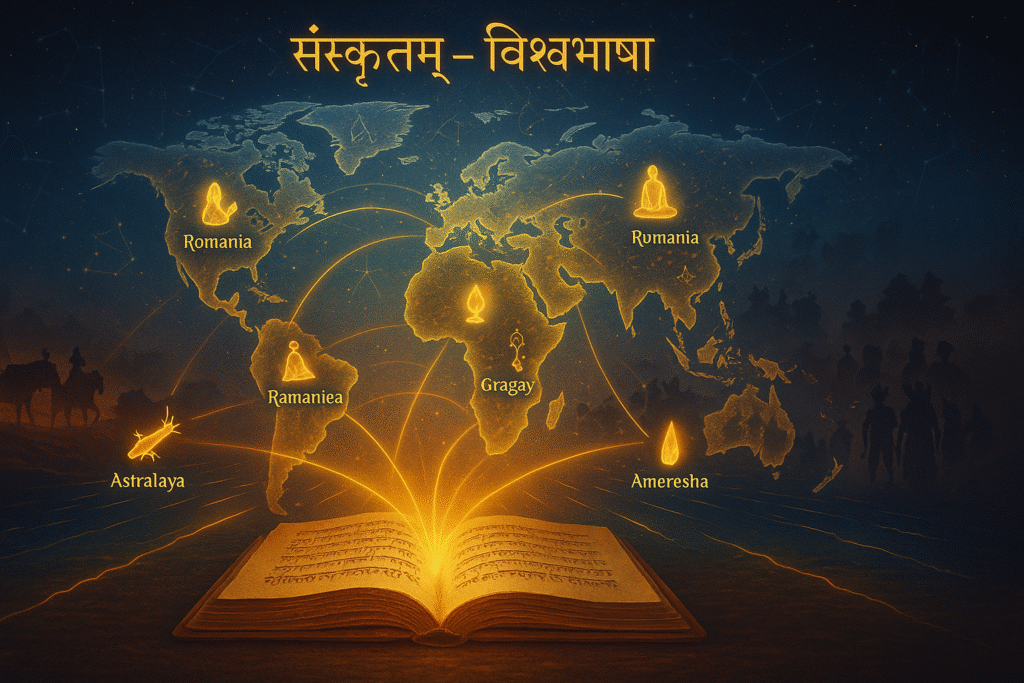
The Ancient Sanskrit Atlas – How the Whole World Spoke the Language of the Vedas
“What if the entire world once spoke Sanskrit?”
This question is no longer a fantasy—it’s a possibility backed by linguistic, mythological, and geographical clues spread across every continent.
Welcome to the Ancient Sanskrit Atlas—a mind-opening journey into the forgotten global legacy of the Vedic civilization, where the place-names of countries, cities, rivers, seas, and mountains across the world reveal deep roots in India’s divine language—Sanskrit.
 Sanskrit: Humanity’s Original Tongue?
The Vedas, India’s ancient scriptures, describe a time when sages traveled across the world, establishing centers of wisdom. Along with them went Sanskrit—the language of the cosmos, mantra, and meaning.
Even today, names like China (Cheen), Japan (Nipun), Russia (Rusheeya), and Siberia (Shibireeya) echo their ancient Sanskrit origins. From Astralaya (Australia), the land of missiles, to Amerisha (America), the land of the immortal lord (Amar-Isha), the world map lights up with Vedic heritage.
 Global Place Names – A Sanskritic Legacy
Here are just a few stunning examples from the Ancient Sanskrit Atlas:
- Australia = Astralaya – The land where powerful weapons were once tested in Ramayana and Mahabharata times.
- Japan = Nipun – Meaning “dexterous” in Sanskrit.
- Russia = Rusheeya – Land of sages (Rishis), with Moscow deriving from Moksha, or salvation.
- Romania = Ramaneeya – Scenic land.
- England = Anguli-Sthan – A land shaped like a finger.
- Germany = Daitya-Sthan – Land of Daityas, ancient Vedic tribes.
- France (Gaul) = Galaya – Named after sage Galav.
- Prague = Pragjyotishpur – A sacred Vedic city.
- America = Ameresha – Land of the Immortal Lord.
Even oceans hold Vedic memories:
- Indian Ocean – Not named by colonizers, but because of India’s naval supremacy.
- Mediterranean = Madhya-Dharaneeya – The central ocean.
- Red Sea = Lohit Sagar, and White Sea = Ksheer Sagar.
 Mountains, Rivers, and More
- Alps = Alpas – Meaning “small” compared to the mighty Himalayas.
- Altai Mountains = Sumeru – The golden mountain of Vedic lore.
- Danube = Danav River – Flowing through the lands of Daityas.
- Nile = Neel Saraswati / Neel Ganga
- Seine (France) = Sindhu
- Thames (England) = Tamsa
Even the Bosphorus derives from Bhasmagaras, a tyrant from Vedic legends.
 Why This Matters
The so-called “myths” of India are not just local stories. They echo in the landscapes of the world—from Europe to the Americas, from Africa to the Pacific. The evidence is not just linguistic—it’s cultural, historical, and spiritual.
It’s time to rewrite history.
The truth is, India was not just a country—it was the origin point of global civilization. Sanskrit was not just a language—it was the matrix of consciousness for humanity.
 Let’s Reclaim the Atlas
Modern maps are drawn with colonial ink. But the Ancient Sanskrit Atlas draws its truth from a time when sages roamed the Earth, when spiritual science guided civilization, and when Sanskrit named the world.
This is not mere coincidence—it is a suppressed truth waiting to be rediscovered.
India was the center of the world.
Sanskrit was the world’s language.
The Vedas were the world’s heritage.
Let us awaken to this truth.
 Call to Action
 Share this with seekers of truth.
 Read more on www.GloriesOfIndia.info
 Subscribe to YouTube: @Glories-of-India
 Scan the QR below to explore the full Sanskrit Atlas.
A Study by Green Guru Dinesh Rawat, Environmentalist, Researcher & Author
www.gloriesofindia.info | www.dineshrawat.live | www.greenmall.in | www.prakritibandhu.org